Basic Counting in Korean and NumerativesKorean words
by DuoCards
*Introduction to Counting and Numeratives*
Hello everyone!
Did You know, that Korea has 2 different number systems?
It is because one originates from Korea, we call it the *Native-korean* number system,
while the other one is derived from Chinese numbers, hence the *Sino-korean* number system.
Keep these expressions in mind, we will be working with them throughout this whole chapter!

숫자
number
이것은 1부터 10까지의 숫자입니다.
계산하다
to calculate, to pay

가격
price
값
value
갑이 되다

비싸다
to be expensive
이 신발이 비싸요.
싸다
to be cheap
이 가방이 싸요.
나이
age
*Sino-korean numbers*
Let´s begin with the Sino-korean numbers from 1 to 10!
If you know a bit of Chinese, you will note that these are very similar :-).

일
one

이
two
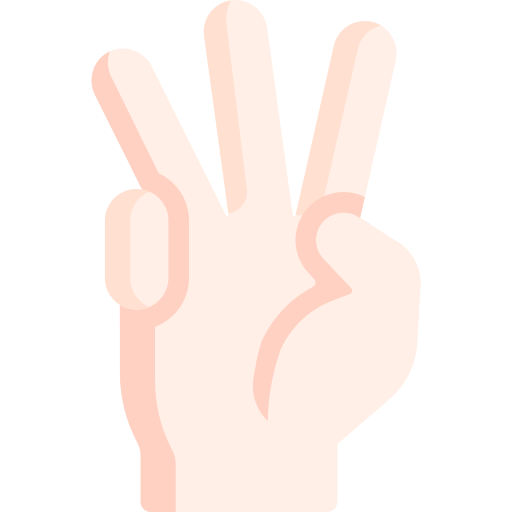
삼
three

사
four

오
Five
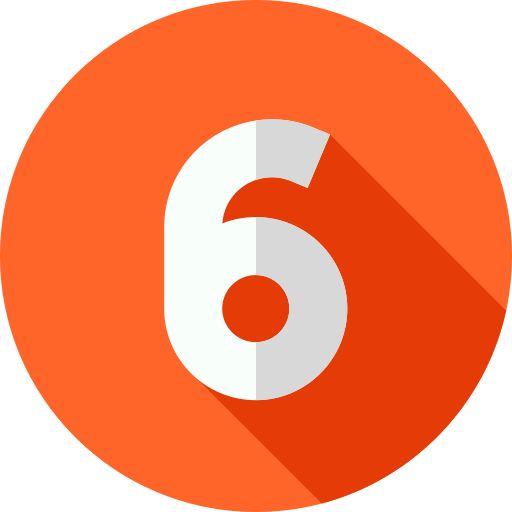
육
Six
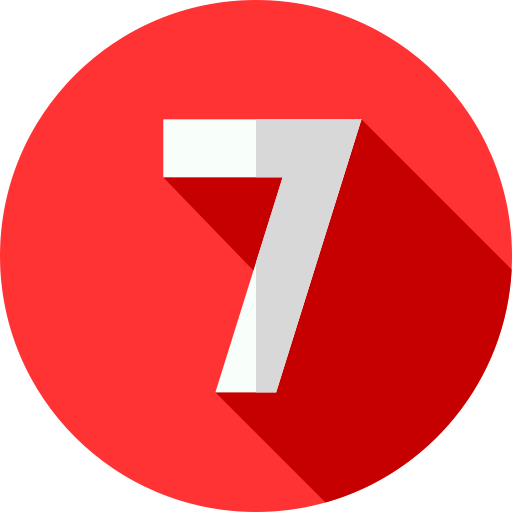
칠
seven

팔
eight

구
nine

십
ten
*Numbers above 20*
When wanting to express numbers from 11 to 19, we simply add "십" in front of the singular number, and we receive e.q. "십삼" - 13, "십오" - 15, "십팔" - 18.
To make higher numbers than 20, we need to ask ourselves - How many 10s are in this number? If we wish to say - for example - 20, we need to say "이십", where "이" is 2, and that is the number of tens in this number (30 - "삼십", 50 "오십", etc...).
If we wish to express a number such as 67, we must put "칠" at the end, so our result is "육십칠". However, we would not actually write "육십칠" when referencing such a number, this is only how it is read. In Korea, arabic numerals are used - the same as in the rest of the world.
이것은 얼마예요?
How much is this?
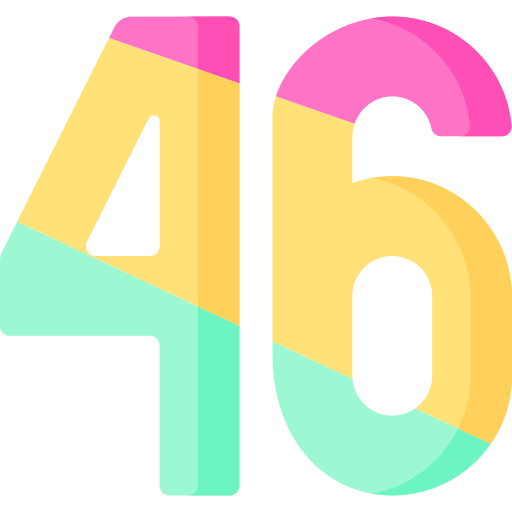
사십육
forty six
이십삼
twenty three

가격은 50원이에요.
The price is 50 won.
혹시 85원은 있어요?
Do you have 85 won by any chance?

동전
a coin
이 10원 동전이 아주 더러워요
This 10-won coin is very dirty.
이 10원 동선이 아ㅏ냐엉튱
*Numbers above 100, and even higher.*
Since goods usually cost at least a thousand won (1 USD or 1 euro usually equals about 1000 won), it is important to get used to dealing with larger numbers.
When counting numbers of several hundred, or thousands, we use the same principle as in the last chapter - we place the number of hundreds first - e.q. "삼백이십" - 320,
"칠백오십육" - 756, or with thousands - "오천사백십삼" - 5413, "구천이백팔십이"- 9282.
With numbers above 10 000, we need the word "만", which stands for the 10 000. So, instead of saying e.q. "이십천" - which is wrong - we need to say "이만" - 20 000.

이 참치 김밥은 5,000원이에요.
This tuna gimbap costs 5,000 won.
새로운 옷이 30,500원이었어요.
The new clothes were 30,500 won.
부산에 가면 기차표는 이만오천원이에요.
If you go to Busan, the train ticket is 25,000 won.

어제 식당에서 30,000원 점심을 샀어요.
I bought a 30,000 won lunch at a restaurant yesterday.

이 콜라는 2,450원이에요.
This Coke is 2,450 won.
*Millions*
Since Koreans use the word "만" for 10,000 or higher, we need to ask ourselves - how many 10,000s are in a million?
So, the answer is a hundred, therefore we can express the number million by saying "백만", or literally - one hundred 10,000s.
An example would be - this car costs 5,000,000 - or - "오백만".

빨간색 자동차는 5,000,000원이에요
The red car costs 5,000,000 won.

떨어지다
drop

집 가격이 1,000,000 달러에서 500,000 달러로 떨어졌어요.
The house price has gone from $1,000,000 to $500,000.
이익
profit
올해는 우리 회사가 10,000,000 유러 이익했어요.
This year our company made a profit of 10,000,000 euros.

올해는 우리 회사가 10,000,000 유러 이익했어요.
This year our company made a profit of 10,000,000 euros.

빚
debt
어떻게 이런 12,520,000원 빚을 갚을 거예요?
How are you going to pay off this 12,520,000 won debt?

도박
gambling

갚다
pay back
도박으로 25,000,000원을 잃었어요.
I lost 25,000,000 won in gambling.
*Other uses*
We can use *Sino-korean numbers* when talking about phone numbers, for example when sharing our contact information verbally.
Also, the various months of the year have their Korean derived from numbers, so e.q. January would be "1월", read as "일월", where "월" means month, we can change the number upwards so it represents February - "2월", March "3월", etc.
Calculations are also done with the *Sino-korean system*.
Finally, we can count minutes, or seconds, in *Sino-korean numbers*. There will be more on this topic in the chapter related to Time.

제 생일은 2월 23일이에요.
My birthday is on February 23rd.

친구의 전화번호는 732_081_999예요.
My friend's phone number is 732-081-999.

5분 동안 달렸어요.
I ran for 5 minutes.

25 더하기 5는 30이에요.
25 plus 5 is 30.

6월 수영 대회에 참석할 거예요?
Are you going to the swim meet in June?

전화는 2분30초만 걸렸어요.
The call took only 2 minutes and 30 seconds.

52 빼기 7은 45예요.
52 minus 7 is 45.
*Native-korean numbers*
The other system is also incredibly useful - we can use it to talk about someone´s age, or we can count a number of objects with it, but first let´s learn about the numbers themselves!

하나
one
둘
two

셋
Three
넷
four

다섯
five
여섯
six
일곱
seven
여덟
eight
아홉
nine

열
Ten
*Numbers above 20*
Differently from the *Sino-korean system*, the numbers 20, 30, or 40, are not derived from the singular numbers 2, 3, 4, etc., but each has unique name!
So we need to learn these words separately, and then combine them with the singular numbers to create numbers such as 23, 45, 72, etc.
스물
twenty

서른
thirty
마흔
forty

쉰
fifty
예순
sixty
일흔
seventy
여든
eighty
아흔
ninety
*Age*
When asking about one´s age in Korean, we must be careful of the formal level we use!
For example, in normal formal Korean, we express age as "나이", while in highly formal situations, we must say "연세" instead.
몇 살이에요?
How old are you?

저는 32살이에요.
I am 32 years old.

우리 엄마가 52살이에요.
My mother is 52 years old.
당신의 연세가 어떻게 되세요?
How old are you?

41살입니다.
I am 41 years old.

선생님의 연세는 83입니다.
The teacher's age is 83.
*Native-korean numeratives*
Numeratives, or counting words, are necessary when we wish to talk about a number of objects from the same class or type.
In a sentence, we need to keep the following order: object - number - numerative
E.q. "연필 1 개" - would translate as one pen.
Some of the most frequently used numeratives are:
"개" - general objects
"마리" - animals
"권" - books
"살" - years of age
"명" - persons
"병" - bottles
"시간" - hours
"장" - flat objects (paper, etc.)
"대" - electronics/machines

펜 1 개를 빌려주세요.
Lend me 1 pen.

이 강아지 2 마리가 너무 귀여워요.
These 2 puppies are so cute.

친구가 몇 살이에요?
How old is your friend?

교실에 교과서 6 권 있어요.
There are 6 textbooks in the classroom.

회의에 회사원 10명이 왔어요.
10 office workers came to the meeting.

우유 3병을 사고 가져오세요.
Buy 3 bottles of milk and bring them.
컴퓨터 2대가 필요해요. (두대 not 이대)
You need 2 computers.

사인 하고 카드 1 장 받으세요.
Sign and get 1 card.

혼자서 소주 4 병을 마셨어요?
Did you drink 4 bottles of soju by yourself?
오늘 친구 5 명과 공원에서 만날 거예요.
Today I will meet 5 of my friends at the park.

기차 3 대의 사진을 찍었어요.
I took pictures of 3 trains.
한국어 사전 2권을 구매했어요.
I bought two Korean dictionaries.
*Buying products*
Of course, combining our knowledge of both number systems, we can now express how many pieces of something we want, and how much should they cost.
Let´s learn about the relevant vocabulary and expressions!
모두 얼마예요?
How much are all of them?

오렌지 1개에 2,000원이에요.
One orange costs 2,000 won.

컴퓨터 1 대 하고 핸드폰 3대는 모두 100,000원입니다.
1 computer and 3 mobile phones are 100,000 won in total.

영화 1 개를 보면 2시간 반쯤 걸려요.
If you watch one movie, it takes about two and a half hours.

어떻게 계산하시겠어요?
How would you like to pay?
신용카드
Credit card

카드로 계산 할 거예요.
I will pay by card.

현금
cash

현금으로 계산 할 거예요.
I will pay in cash.
영수증이 필요하세요?
Need a receipt?
*Time in Korean*
Since we know both numerical systems, we can learn how to express time in Korean.
When telling what time it is, we use the words "시" - for hours and "분" for minutes.
As we already know, we need to use *Native-korean numbers* for hours, and *Sino-korean numbers* when counting minutes.
However, when saying how long something takes, we need to express hours with "시간", instead of "시".
1시간
1 hour
1시
1 o'clock
우리가 2시에 만나요?
Shall we meet at 2 o'clock?

저는 7시에 일어나요.
I get up at 7 o'clock

까지
Till

제 엄마가 8시까지 일해요.
My mom works until 8 o'clock.

부터
from

수학 수업이 9시부터 시작해요.
Math class starts at 9:00.

그런 수업이 2시간 걸려요.
Such a class takes 2 hours.
제 아빠가 5시 45분에 퇴근해요.
My dad gets off work at 5:45.
*Morning and Afternoon, AM and PM*
Koreans do not use the 24-hour time schedule, instead, they only count hours on the clock up to 12, and emphasize morning by adding "오전", while afternoon, or PM, would be "오후".
So we can express times on the clock in the following manner:
"오전 6시" - 6:00 AM
"오후 2시" - 2:00 PM

보통 오전 7 시 반에 일어나요.
I usually get up at 7:30 am.

가게가 오후 5시에 문을 닫아요.
The shop closes at 5pm.

운동이 오전 4시 반부터 2시간 걸려요.
The exercise takes two hours from 4:30 in the morning.

동안
During

주말마다 오후 1시부터 3시간 동안 한국어를 배워요.
I learn Korean for 3 hours from 1:00 pm every weekend.
금요일은 오후 7시 50분에 기차역 앞에서 만나자.
Let's meet at the train station at 7:50 on Friday.
*Before and After*
Finally, we can learn how to say before - "전에", and after - "후에".
We can put these expressions after a noun and express the meaning after this activity.
수업 전에
before class

운동 후에
after exercise

오후 5시에 집에 가기 전에 쇼핑을 갈 거예요.
I will go shopping before going home at 5:00 PM.

오전 6시 일어난 후에 이를 닦아요.
I brush my teeth after waking up at 6 am.

기차가 멈춘 후에 내리세요.
Get off the train after it stops.
*Well done!*
Now, after learning all the different ways of counting in Korean, you will be able to talk about prices, the number of objects, age, and expressing the time, or the duration of a certain activity!
See you in the next lesson!

수업 후에 무엇을 기억해요?
What do you remember after class?

다음 수업을 시작하기 전에 연습해보세요.
Practice before the next lesson.

주말에 얼마 동안 한국어를 공부해요?
How long do you study Korean on the weekend?

식당에서 음식 가격을 계산 할 수 있어요.
You can calculate the price of food in a restaurant.

수고했어요!
Thanks for your work!