Basic courseSpanish words
by DuoCards
*Welcome to the Spanish Basic Course!*
This course will give you the essentials to *feel more confident in Spanish.*
We’ll review the present tense with tricky verbs, practice comparing adjectives, and cover practical topics like weather, numbers, nationalities, and more.
But first, let’s start with *a quick recap* of essential Spanish phrases and words that always come in handy.

Hola, ¿cómo te llamas?
Hello, what is your name?

¡Buenos días!
Good morning!
¡Buenos días! ¿Cómo te sientes hoy?

Me llamo…
My name is...
Me llamo Juan. ¿Y tú?

¿Cómo estás?
How are you?
Hola, Juan. ¿Cómo estás?

Bien, gracias. Y tu?
Fine, thank you. And you?

muy bien
very well
Estoy muy bien, gracias.

No entiendo.
I do not understand.
¿Puedes repetir eso? No entiendo.

Yo soy Antonio.
I am Antonio.

¿Hablas inglés?
Do you speak English?
Hola, ¿hablas inglés o español?

¡Buenas tardes!
Good afternoon!
*Weather expressions I.*
Let's talk about the weather! In Spanish, we use the verb "hacer" (literal meaning: to do or to make) to describe the weather.
"Hace frío."
"Hace calor."

Hace calor.
It is hot.

Hace sol.
It's sunny.

¿Qué tiempo hace?
What's the weather like?

Hace viento.
It is windy.

el viento
wind
El viento sopla fuerte hoy.
el tiempo
time / weather
¿Qué tiempo hace?

Hace buen tiempo.
The weather is good.
la temperatura
the temperature
La temperatura se mide con el termómetro.

Hace fresco.
It is chilly.
Hace fresco en la casa.
la brisa
the breeze
Me encanta la brisa.
*Using HAY in Spanish*
*Hay* means *there is* or *there are.* It never changes, whether the noun is singular or plural:
"Hay un perro." - There is a dog.
"Hay tres perros." - There are three dogs.
You can use it to ask or deny existence:
"¿Hay un baño?" Is there a bathroom?
"No hay leche." There isn’t any milk.
In short, "hay" is always the same and is only used to say that something exists or is present.
"Hay un libro en la mesa."
"Hay dos perros en el jardín."

Hay un libro en la mesa.
There is a book on the table.

Hay un perro en el jardín.
There's a dog in the garden.

¿Hay un baño?
Is there a toilet?

la /el estudiante
the student
Hay muchos estudiantes en la clase.
la biblioteca
the library
Me gusta estudiar en la biblioteca.

Hay tres estudiantes en la biblioteca.
There are three students in the library.
¿Hay alguien más en la biblioteca además de los tres estudiantes?

No hay problema.
No problem.

un parque
a park
Vamos a jugar en un parque.

Hay un parque grande en mi ciudad.
There is a large park in my city.

Hoy no hay clases.
There are no classes today.

interesante
interesting
No hay nada interesante.
*Interrogative pronouns - pronombres interrogativos*
Most used are these:
"qué" (what)""
"cómo" (how)
"cuál" (which),
"quién" (who)
"dónde" (where)
"de dónde" (from where)
"cuándo"" (when)
"cuánto/a" (how much)
"cuántos/as" (how many)
"por qué" (why)
Remember that in a question, the pronoun is at the beginning and has an accent.

¿Cómo te llamas?
What is your name?

comenzar
to begin
¿Cuándo comienza?

¿Cuánto cuesta este coche?
How much does this car cost?

el actor
the actor
El actor es de Brasil.

¿Cuál es su actor favorito?
Who is your favourite actor?

la cosa
the thing
¿Cuántas cosas están allí?

¿Qué es eso?
What is it?

el esposo
the husband
¿De dónde es tu esposo?

¿Dónde está tu padre?
Where is your father?

el cantante
the singer
¿Quién es este cantante?

¿Por qué no habla?
Why doesn't he speak?
*Country /nationality /language - país/ nacionalidad/idioma*
e.g.:
"Brasil / brasileño(a) / portugués"
"Canadá / canadiense / inglés" o "francés"
"Estados Unidos / estadounidense / inglés"
"Israel / israelí / hebreo"
"Italia / italiano(a) / italiano"
"¿De dónde eres?" - "Yo soy de Chile."
"¿Qué lenguas hablas?" - "Yo hablo italiano, inglés y chino."
In some cases, nationalities and languages are the same words.
e.g.: "el italiano" (italian language) x "italiano" (adjective)
"Me gusta gusta el italiano."
"Este chico italiano es muy simpático."

polaco/polaca
Polish
Ella es polaca.

portugués/portuguesa
Portuguese
El fútbol portugués es muy famoso.

árabe
Arabic
La letra árabe es muy difícil.

Hablo muchos idiomas como chino o francés.
I speak many languages such as Chinese and French.

ucraniano/ucraniana
Ukrainian
Usted es un hombre ucraniano.

alemán / alemana
German
Vuestra familia es alemana.

el país
the country
No conozco este país.

Nosotros somos de México, somos mexicanos.
We are from Mexico, we are Mexicans.
Somos mexicanos.

traducir
translate
Traduzco el chino.

griego/griega
Greek
Me gusta la historia griega.

extranjero/extranjera
foreign
Es una familia extranjera.

vietnamita
Vietnamese
La cocina vietnamita es muy buena.

Su padre es de Italia.
His father is from Italy.
El padre de María es italiano.

el japonés
Japanese
No hablamos nada de japonés.
La cocina china contiene mucha carne.
Chinese cuisine contains a lot of meat.
Me encanta la cocina china porque contiene mucha carne.
*Like - gustar/encantar*
Gustar is used to express that *you like* something. It is used only in the third person.
For example "A mí me gusta español."
- The verb gustar or encantar must be joined to a pronoun: "me gusta" ("te gusta",...)
- We use the prepositional phrase "a mí" ("a tí",...) to give more emphasis on the person who likes the thing.
*Forming the sentence:*
A mí (tí, él/ella/usted, nosotros/as, vosotros/as, ellos/as) + (me, te, le, nos, os, les) + gusta/gustan + noun or infinitive verb.
"A mí me gusta español."
"A tí te gusta español."
"A él/ella/usted le gusta español."
"A nosotros nos gusta español."
"A vosotros os gusta español."
"A ellos/ellas/ustedes les gusta español."
Whether to use gusta or gustan depends on the words that come after (las cosas que te gusta).
"gusta" ("encanta") + singular noun or verb
"A mí me gusta el coche."
"gustan" ("encantan") + plural noun
"A él le gustan los coches."

cantar
to sing
A mí me gusta cantar.

¿A tí te gusta cantar?
Do you like to sing?

cocinar
to cook
¿A tí te gusta cocinar?

la música
the music
Estudiar con música de fondo me ayuda a concentrarme.

No me gusta la música en este concierto.
I don't like the music in this concert.
No me gusta la música en este concierto. Prefiero otros géneros.

viajar
to travel
Me gusta viajar.

Nos gusta viajar.
We like to travel.

la ciudad
the city
Roma es una ciudad.

Me gusta esta ciudad.
I like this city.

bailar
to dance
¿A vosotros os gusta bailar?

No me gusta cocinar.
I don't like to cook.

A mí me encantan esas canciones.
I love these songs.

la fiesta
the party
¿Te gusta la fiesta?
*Present tense - irregular verbs I.*
First, let's take a look at the three most important irregular verbs in the present tense.
*To be - SER*
"yo soy"
"tú eres"
"él/ella/usted es"
"nosotros/nosotras somos"
"vosotros/vosotras sois"
"ellos/ellas/ustedes son"
*To be - ESTAR*
"yo estoy"
"tú estás"
"él/ella/usted está"
"nosotros/nosotras estamos"
"vosotros/vosotras estáis"
"ellos/ellas/ustedes están"
*To go - IR*
"yo voy"
"tú vas"
"él/ella/usted va"
"nosotros/nosotras vamos"
"vosotros/vosotras vais"
"ellos/ellas/ustedes van"

Nosotros vamos a la playa.
We go to the beach.

Soy una chica japonesa.
I am a Japanese girl.
¿Eres una chica japonesa?

los padres
parents
Mis padres son muy agradables.

Ustedes son profesores.
You are teachers
Ustedes son unos profesores muy amables.

la universidad
the university
No hay universidades en esta ciudad.

¿Cuándo te vas a la universidad?
When do you go to university?

cansado
tired
¿Estás cansado?

Estoy enfadado con mi madre.
I am angry with my mother.

Nosotras estamos felices.
We are happy.

Mis padres van de vacaciones a Francia.
My parents go on vacation to France.
*Present tense - irregular verbs II.*
In Spanish, irregular verbs are grouped according to which letters they modify.
We change:
*e* to *ie* (e.g. "querer" → "yo quiero", "cerrar" → "yo cierro")
*o* to *ue* (e.g. "poder" → "yo puedo", "volver" → "yo vuelvo")
in the first, second and third person of singular form and in the third person of plural form.
e.g. "querer"
"yo quiero"
"tú quieres"
"él/ella/usted quiere"
"nosotros/nosotras queremos"
"vosotros/vosotras queréis"
"ellos/ellas/ustedes quieren"
e.g. "poder"
"yo puedo"
"tú puedes"
"él/ella/usted puede"
"nosotros/nosotras podemos"
"vosotros/vosotras podéis"
"ellos/ellas/ustedes pueden"

tú puedes (poder)
you can
¿Puedes venir a mi casa?

¿Qué puedes cocinar?
What can you cook?
yo duermo (dormir)
I sleep
Duermo 8 horas al día.

Nosotros dormimos en la casa de nuestro amigo.
We sleep at our friend's house.

entender
understand
Entiende todo.

No entiendo nada.
I don't understand anything.

tú recuerdas (recordar)
you remember
Sí, sólo tú recuerdas.
¿Recuerdas cómo se juega esto?
Do you remember how to play this?

mañana
tomorrow
Nos vemos mañana.

Vosotros volvéis mañana.
You (plural) come back tomorrow.

la puerta
the door
Es una puerta azul.

Él cierra la puerta.
He closes the door.

Te quiero.
I love you.
*Present tense - irregular verbs - III.*
*e* a *i* (e.g. "pedir" → "yo pido", "seguir" → "yo sigo")
*u* to *ue* (e.g. "jugar" → "yo juego",)
in the first, second and third person singular and in the third person plural.
*c* changes to *zc* in the first person:
e.g. "conocer" → "yo conozco", "conducir" → "yo conduzco"
*meet*
"yo conozco"
"tu conoces"
"él/ella/usted conoce"
"nosotros/nosotras conocemos"
"vosotros/vosotras conocéis"
"ellos/ellas/ustedes conocen"

pedir
ask
Le pedí permiso a mi jefe para salir temprano.

él juega
he plays
Él juega fútbol.

usted mueve (mover)
you move (formal)
Usted mueve las cosas.

nosotros vestimos (vestir)
we dress
Nosotros vestimos a los hijos.

ella vuela (volar)
she flies
Ella vuela a Italia.

No conozco a nadie.
I don't know anyone.

nosotros repetimos (repetir)
we repeat
Repetimos las clases.

ellos piensan (pensar)
they think
Ellos piensan mucho.

Veo que conduces muy bien.
I see that you drive very well.
conduzco (yo)
*Present tense - irregular verbs - IV.*
Verbs with *g* in the first person:
e.g. "poner" → "yo pongo", "tener" → "yo tengo", "decir" → "yo digo"
"yo pongo"
"tu pones"
"él/ella/usted pone"
"nosotros/nosotras ponemos"
"vosotros/vosotras ponéis"
"ellos/ellas/ustedes ponen"
Other verbs with changes in the first person:
e.g. "saber" → "yo sé", "ver" → "yo veo"

tú tienes
you have
Él tiene un gato negro.

yo hago (hacer)
I do
Yo hago la tarea.

el deporte
the sport
Practicar deporte cada día es bueno.

Haces mucho deporte.
You do a lot of sport.

yo digo
I say
Yo no digo la verdad.

nosotros salimos (salir)
we go out
Nosotros salimos temprano.

yo vengo (venir)
I come
Yo vengo a las 10 de la noche.

tú ves
you see
¿Lo ves?

Ella ve mal.
She sees badly.

él sabe
he knows
Él sabe todo.

No sabe nada.
He knows nothing.
*Other adjectives - otros adjetivos*
Most adjectives that end in a consonant have the same form for masculine and feminine but they change form for singular or plural. In plural we add -es.
e.g.:
"la bailarina popular" / "el bailarín popular"
"las bailarinas populares" / "los bailarines populares"

triste
sad
Es una persona triste

Los estudiantes están tristes.
The students are sad.
gordo
fat
Somos un poco gordas.

delgado
slim
Es una chica alta y muy delgada.

corto
short
Esa película es corta.

largo
long
Tiene pelo largo.
difícil
difficult
El test es muy difícil.
la lección
the lesson
Es una lección difícil.

el nivel difícil
the difficult level
Me gustan los juegos de nivel difícil.
fácil
easy
Es un problema fácil de resolver.

el exámen fácil
the easy exam
Tenemos un exámen muy fácil.

divertido
fun
El concierto es divertido.

enfadado
angry
Estoy enfadada con mi hijo.
*Comparison of adjectives - comparación de adjetivos*
Comparative adjectives - comparison of two or more things.
There are two options how to compare two or more things:
"más" + adjective + "que"
"menos" + adjective + "que"
or
"tan" + adjective + "como"
"La biología es más interesante que las matemáticas."
"Marina es menos rápida que Julia."
"Ella es tan guapa como su madre."
Superlative adjectives - the highest level of quality
Forming: definite article + "más" / "menos" + adjective
"Marta es la más guapa."

menos guapo que
less handsome than
Tu perro es menos guapo que el mío.

fuerte
strong
Eres fuerte.

Mi padre es el más fuerte.
My father is the strongest.

Carlos es más fuerte que Juan.
Carlos is stronger than Juan.

Soy más joven que tú.
I'm younger than you.

alta
tall
El chico es alto.

Mi hermano es tan alto como tú.
My brother is as tall as you.

favorito
favourite
La chica más favorita de la clase es Ana.

la película
the movie
Es una película extranjera.

Mi película favorita es Harry Potter.
My favourite film is Harry Potter.
*Expressions: Tener que / Hay que*
Tener que + infinitive - obligation or necessity. This expression can be translated as someone has to do something.
"Tengo que ir a la escuela."
"Tenemos que comer más."
"Tienes que salir más con tus amigos."
Hay que + infinitive - when we want to express that it is necessary to do something.
"Hay que estudiar toda la vida."
"Hay que hacer más deporte."
"Hay que beber menos alcol."

Ella tiene que comprar una camiseta.
She has to buy a t-shirt.

aprender
to learn
Aprendo español.

Hay que aprender cosas nuevas.
New things need to be learned.

la verdad
the truth
Quiero enseñarte la verdad.

Hay que decir la verdad.
It is necessary to tell the truth.

escuchar
to hear / listen
Hay que escuchar la radio.

vender
to sell
Vende sus coches.

Tiene que vender su casa.
He has to sell his house.

comprar
to buy
Yo tengo que comprar algo.

Tenemos que comprar unas manzanas.
We need to buy some apples.
*Weather expressions II.*
There are also weather expressions that use the verb hay:
"Hay humedad."
We can use estar + adjective:
"Está nublado."
Or we can use just a single verb:
"Llueve." (llover)

el sol
the sun
Hay sol.

la luna
the moon
la Luna tarda 28 días en dar la vuelta a la Tierra.

Hay luna llena.
There is a full moon.

las nubes
the clouds
Hay nubes.
Está nublado.
It is cloudy.

la humedad
humidity
Hay mucha humedad en este país.

Hay tormenta.
There is a storm.

la lluvia
the rain
Hoy llueve mucho.

el paraguas
the umbrella
Tengo un paraguas de color rojo.

el arcoirís
the rainbow
Veo el arcoirís.

nevar
to snow
Este año nieva mucho.

Hoy llueve y nieva.
Today it is raining and snowing.

tronar
to thunder
Truena fuerte.
*Numbers I.*
0 - "cero"
1 - "uno" "
2 - "dos"
3 - "tres"
4 - "cuatro"
5 - "cinco"
6 - "seis"
7 - "siete"
8 - "ocho"
9 - "nueve"
10 - "diez"
_____________
11 - "once"
12 - "doce"
13 - "trece"
14 - "catorce"
15 - "quince"
16 - "dieciséis"
17 - "diecisiete"
18 - "dieciocho"
19 - "dienueve"
20 - "veinte"
If you want to express that *tomorrow is your birthday*, remember that in Spanish the noun "cumpleaños" is same in *singular* and in *plural* form.

el número
the number
Mi número favorito es el siete.

cero más uno es uno
zero plus one is one

cinco más cinco es diez
five plus five is ten

Tiene quince gatos en su casa.
He has fifteen cats at home.

Mi hermana tiene tres años.
My sister is three years old.

seis menos dos es cuatro
six minus two is four

la fecha
the date
Poner la fecha a un documento.

el cumpleaños
the birthday
¡Feliz cumpleaños!

Mi cumpleaños es mañana.
My birthday is tomorrow.

siete más siete es catorce
seven plus seven is fourteen
¿Cuándo es tu cumpleaños?
When is your birthday?

Mis hermanos no tienen dieciocho años.
My brothers are not eighteen.
*Days of the week - Los días de la semana*
"Lunes"
"Martes"
"Miércoles"
"Jueves"
"Viernes"
"Sábado""
"Domingo"
In case you want to say on Monday, remember that in Spanish you use "el lunes".
*The seasons of the year - las estaciones del año*
"la primavera"
"el verano"
"el otoño"
"el invierno"

la semana
week

El lunes tengo mucho trabajo.
I have a lot of work to do on Monday.

el fin de semana
weekend
Nos vemos los fines de semana.

el mes
the month
Este mes no quiero bailar.
Los fines de semana vamos a la playa.
At weekends we go to the beach.
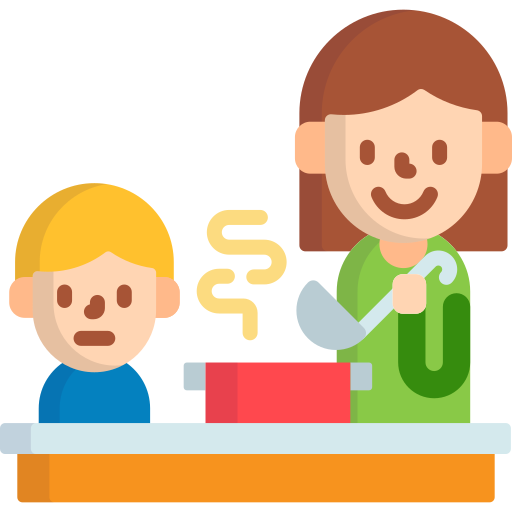
El jueves cocina con su hermana.
On Thursday she cooks with her sister.

Los sábados juega al tenis.
On Saturdays he plays tennis.

La clase empieza el lunes.
The class starts on Monday.

cada
each
Cada lunes voy al teatro.

el año
year
El año es muy largo.

las estaciones del año
the seasons of the year
Hay cuatro estaciones del año.

el invierno
winter
Mi estación favorita es el invierno.

nadar
to swim
Nadar es divertido.

En verano nos gusta nadar.
In summer we like to swim.
*Verbs with preposition A*
*Ver + a*
In the previous course we mentioned some prepositions.
In addition to expressing place (in the sense of to), the preposition "a" is also used before name or noun that represents a person or a pet.
The preposition in these cases usually is not translated.
Remember if is not a person or a pet we do not use "a" "Veo un libro."
There are other verbs, e.g.:
*Aprender + a*
*Empezar + a*

Vemos a mi madre.
We see my mother.

llamar
to call to someone
Llama a Diego.

Digo todo a mis amigos.
I tell my friends everything.

Quiero mucho a mi gato.
I love my cat very much.

conocer a
to meet
Conocemos a Pedro.

Aprendemos a hablar sueco.
We learn to speak Swedish.

Empiezan a entender la gramática.
They begin to understand grammar.

odiar a
to hate
Odio a la hija de su hermana.
* To describe a person - Describir una persona*
When we are describing a person, we use the verb "ser", which expresses a permanent quality. In other cases we use the verb "tener".

el pelo
the hair
Tiene pelo corto.

el pelo rubio
blonde hair
Yo tengo el pelo rubio.

La mujer es alta y delgada.
The woman is tall and slim.

llevar gafas
to wear glasses
Llevo gafas desde el año 2020.

rizado
curly
Usted tiene pelo rizado y moreno.

No me gusta el pelo liso.
I don't like straight hair.

las pecas
freckles
En verano tiene pecas.

Mi hermano es calvo.
My brother is bald.

la barba
the beard
Nuestro padre tiene barba.

azul
blue
El azul es muy bonito.

los ojos
the eyes
Me gustan sus ojos azules.

Pedro no tiene unos ojos azules sino verdes.
Pedro does not have blue eyes but green ones.

el pelo moreno
brown hair
Tengo pelo moreno.
*Adverbs I.*
Spanish adverbs are formed by adding the ending "-mente" to the feminine form of the adjective, although some adjectives can be used unchanged e.g. "rápido".
Irregular adverbs are two: "bien" and "mal".
*Comparative adverbs*
We construct the comparative using "tan … como" (equality), "más … que" (superiority) or "menos que" (inferiority).
e.g.:
"Pedro lee tan claramente como María."
"Pedro lee más/menos claramente que María."
Exceptions:
*bien* "mejor"
*mal* "peor"
e.g.:
"Pedro lee mejor/peor que María."

Él corre rápido.
He runs fast.

claramente
clearly
Claramente es un perro.

fácilmente
easily
Lo hace facilmente.

Eso está muy mal.
That's too bad.

Muy bien chicos!
¡Great job guys!

el mundo
the world
El mundo es grande.

el equipo
the team
Es un equipo de básquetbol.

Mi equipo juega mejor.
My team plays better.
tan bien
so well

tranquilamente
quietly
Dicen la verdad tranquilamente.

nuevamente
again
Lo hace nuevamente.

María canta mejor que mi hermana.
Maria sings better than my sister.