Basic course IIGerman words
by DuoCards
*What a wunderschön world!*
Adjectives are used to describe or characterize things or people. They are necessary to make the meanings of sentences more exact or clearer.
First, let's look at some adjectives to describe an emotion or feeling.

Mir geht es gut.
I'm doing good.
Mir geht es gut, danke.

Wie geht es dir?
How are you?

schlecht/schlimm
bad
Das Wetter ist schlecht.

glücklich
happy + lucky
Sie ist glücklich.

Bist du glücklich?
Are you happy?

traurig
sad
Bist du traurig?
Warum ist er traurig?

Warum ist er traurig?
Why is he sad?
Er ist immer traurig.

enttäuscht
disappointed
Er war enttäuscht.

Ich bin enttäuscht.
I am disappointed.

toll
great
Das ist toll!
*I'm taller than you!*
To compare things in German is actually pretty easy!
*The comparative* is the first form of comparison. The ending *-er* is added to the adjective and the sentences is constructed with "als" (than).
e. g. "Sie ist schöner als du."
*The superlative* is the highest form of comparison. We put "am" or *the definite article* in front of the adjective, and add *-ste(n)* to the end. The formation is the same for all adjectives regardless of how many syllables they have.
e. g. "Sie ist am schönsten."
Adjectives that end with *-d/-t or -s/-ß/-x/-z* usually form the superlative with *-este(n).*
e. g. "interessant" - "am interessantesten"

Wer ist am schnellsten?
Who is the fastest?

als
than / as
Ich bin schneller als du.

Er ist schneller als ich.
He is faster than me.

schöner als ich
more beautiful than me
Die Frau ist schöner als ich.

am schönsten
the most beautiful

klein
small
Mein Haus ist klein.

Mein Bruder ist kleiner.
My brother is smaller.

laut
loud
Die Musik ist zu laut.
Kannst du lauter sprechen?
Can you speak louder?
kannst du nicht lauter sprechen?

Dieser Artikel ist interessanter.
This article is more interesting.
Die neue Ausstellung ist viel interessanter als die alte.
*Irregular comparative forms.*
As in English, some German adjectives have *irregular comparative forms.*
*Here are some examples:*
"gut" - "besser" - "am besten / der/die/das beste"
"viel" - "mehr" - "am meisten / der/die/das meiste"
"hoch" - "höher" - "am höchsten / der/die/das höchste"
Mir geht es besser.
I feel better.
Geht es dir besser?
Geht es dir besser?
Are you feeling better?

am besten
preferably / the best
Am besten machst du das heute.

Du bist der beste!
You (M) are the best!
Du bist der beste Koch, den ich kenne.

das Gebäude
the building
Siehst du das Gebäude?

das höchste Gebäude
The tallest building
Das höchste Gebäude der Welt ist in Dubai.

mehr Zeit
more time
Hast du mehr Zeit?

verdienen
to earn (money at work)
Er verdient viel.

Er verdient mehr als ich.
He earns more than I do.

die meisten Leute
most people
Die meisten Leute sind Rechtshänder.
*Have you already finished? Not yet!*
Let's learn how to use words "noch" and "schon"!
In German, the adverb "noch" has the meaning of *still*, *even* and *more*.
"Ich bin noch zu Hause." - I'm still at home.
"Möchtest du noch Kaffee?" - Would you like some more coffee?
"Mein Haus ist noch näher." - My house is even closer.
In contrast to "noch" where something is still going on, "schon" means *already* or *yet* in English.
"Bist du schon fertig?" - Are you already finished?
"Ich war schon mal hier." - I was already here.

schon besser
already better
Mir geht es schon besser.

Ihm geht es schon besser.
He is already feeling better.

noch schlimmer
even worse
Kann es noch schlimmer sein?
Kann es noch schlimmer sein?
Can it be any worse?
Diesen spiel, kann es noch schlimmer sein?

noch nicht
not yet
Ich bin noch nicht fertig.

Bist du schon da?
Are you already there ?
Ich bin noch nicht da.
I'm not there yet.

Kommst du schon?
Are you coming already?

Wir haben noch Zeit.
We still have time.
*Doch, doch!*
"Doch" is one of those wonderful words in German that people who speak German wish existed in English.
You use "doch" to convey mood or emphasis. It has no specific grammatical purpose, but the feeling of a sentence changes when you add or remove it.
Because "doch" has no specific meaning that can be translated to an English word, you have to learn it in context, through examples.
There are *five main uses* of the word "doch" in German:
To counter a negative
"Hast du keine Zeit?" / "Doch! Ich habe Zeit." - Don't you have time? / I *do* have time!
To say *actually*, *and yet*, *after all*, or *but*
"Ich habe morgen doch Zeit." - I have time tomorrow *after all.* (I originally thought I didn’t)
To tone down statements
"Gehen Sie doch vorbei!" - *Why don’t you* go by?
To seek confirmation
"Du hast doch meine Email bekommen?" - You *did* get my email, *right*?

Wir haben doch noch Zeit.
We still have time (after all).

Ich habe es doch gesagt.
I told you so.
Sage ich doch!
That's what I'm saying!

Ich bin doch noch hier.
I'm still here.

Wir sind doch schon da.
We are already there.

Du kennst mich doch!
You know me!

Komm doch vorbei!
Why don't you come over?
*Reflexive Verbs*
In a reflexive clause, *the action is done to the person carrying out that same action*. Reflexive clauses only can be formed by certain verbs. These verbs are called *reflexive verbs*.
In English, these verbs are characterized by using *oneself*, *yourself*, *ourselves*, etc. In German, the infinitive of these verbs is preceded by the pronoun "sich".
Reflexive verbs in German can be reflexive in the accusative or in the dative. Most reflexive verbs are accusative.
*Reflexive pronouns in the accusative*:
"ich" - "mich"
"du" - "dich"
"er/sie/es" - "sich"
"wir" - "uns"
"ihr" - "euch"
"sie/Sie" - "sich"

sich fühlen
to feel
Wie fühlst du dich?
Ich fühle mich schlecht.
Fühlst du dich gut?

Ich fühle mich schlecht.
I feel bad.

Fühlst du dich gut?
Are you feeling well?

sich freuen
to be happy (about something)
Ich freue mich darüber.

Ich freue mich sehr!
I am very happy!

Wir freuen uns auch.
We are happy too.

(Es) Freut mich!
Pleased to meet you!

sich treffen
to meet
Wann treffen wir uns?

Wir treffen uns morgen.
We'll meet tomorrow.

Treffen wir uns heute noch?
Are we still meeting today?
*What do you need this für?*
You've already learned how to use the accusative in the Basic Course I. Now let's learn something more to it. There're certain prepositions in German, which *always* go with the *accusative*. For example "für".
"Das ist für dich." - That's for you.
"Ich habe die Jacke für zehn Euro gekauft." - I bought the jacket for ten euros.

für mich
for me
Ist das Geschenk für mich?

Kannst du für mich etwas tun?
Can you do something for me?

Ich habe nichts für dich.
I have nothing for you.
für meinen Bruder
for my brother
Ein Geschenk für meinen Bruder.

Ich kaufe es für meinen Bruder.
I'm buying it for my brother.

Ist das für deine Freundin?
Is that for your girlfriend?

Was kaufst du für deine Mutter?
What are you buying for your mother?

sich freuen für
be happy for
Ich freue mich für dich.

Ich freue mich für dich.
I am happy for you.

für immer
forever
Ich bin für immer dankbar.

Sie bleiben für immer zusammen.
They stay together forever.

für einen Monat
for one month
Ich bleibe hier für einen Monat.
*Say something!*
There are three main forms of *the imperative* that are used to give *instructions or orders* to someone. These correspond to the three different ways of saying you: "du", "ihr" and "Sie". However, it is only in the "Sie" form of the imperative that *the pronoun usually appears* – in the "du" and "ihr" forms, *the pronoun is generally dropped*, leaving only the verb.
"Du sagst etwas." "Sag etwas!"
"Ihr sagt etwas." "Sagt etwas!"
"Sie sagen etwas." "Sagen Sie etwas!"
Note that the *-e* of the "du" form is often dropped, but *NOT where the verb stem ends*, for example, in *chn-, fn-, or tm-*. In such cases, the -e is kept to make the imperative easier to pronounce.
e. g. "öffnen" "Öffne die Tür!"

Mach etwas!
Do something!

Lass mich in Ruhe!
Leave me alone!

die Tür(en)
the door
Kannst du die Tür offnen?

öffnen
to open
Öffnest du die Tür?

Öffnen Sie die Tür, bitte.
Open the door, please. (formal)

Sag mal
tell me
Sag mal, was machst du am Abend?

Komm schon!
Come on!
Komm schon! Du kannst es mir doch sagen!

der Unsinn
the nonsense
Was für ein Unsinn!
Red doch nicht so einen Unsinn
Mach keinen Unsinn

Mach keinen Unsinn!
Don't do anything stupid!
*Please, be quiet!*
Note also that the verb "sein" (to be) is a *strong, irregular verb*. Its imperative forms are also irregular!
"Du bist böse." "Sei nicht böse!" Don't be mean/angry!
"Ihr seid böse." "Seid nicht böse!" Don't be mean/angry! (plural)
"Sie sind böse." "Seien Sie nicht böse!" Don't be mean/angry! (polite)

Seid ruhig!
Be quiet! (plural)
Seid ruhig, Kinder!

Sei nicht so!
Don't be like that!
Sei nicht böse!
Don't be angry!

Sei bitte leise.
Please be quiet.

geduldig
patient / patiently
Ich bin nicht besonders geduldig.

Seien Sie bitte geduldig.
Please be patient. (formal)
*Tell mir!*
The dative case ("der Dativ") describes the *indirect object* of a sentence in German and English and answers the question, "wem?" (whom), or "was?" (what).
In the dativ case, "ich" becomes "mir" and "du" becomes "dir".
Some verbs in German only go with the dativ case, e. g. "sagen", "schenken", "gehören", "helfen", "geben", etc.
"Sag mir etwas." Tell me something.
"Ich schenke dir Blumen." I give you flowers.

Ich gebe dir mein Wort.
I give you my word.

schenken
to give a gift
Ich schenke dir Blumen.

Was schenkst du mir?
What are you giving me?
antworten
to reply / to answer
Warum antwortest du nicht?

Antworte mir!
Answer me!

sag mir
tell me (dativ)
Sag mir etwas.

Sag mir ehrlich!
Tell me honestly!

gehören
to belong
Wem gehört das Auto?

Das Auto gehört mir.
The car is mine.

Es gehört dir nicht.
It's not yours.
*Ich und du*
Coordinating conjunctions are connecting words that don’t disturb the word order of the German sentence.
"und" *and* "Ich habe eine Katze und einen Hund."
"oder" *or* "Ich gehe ins Restaurant oder ich bleibe zu Hause."
"aber" *but* "Er verdient nicht viel, aber kauft ein neues Auto."
"denn" *because* "Ich arbeite jeden Tag, denn ich brauche Geld."
und
and
Meine Mutter und ich gehen einkaufen.

wir und ihr
we and you (pl.)
Wir gehen und ihr bleibt.

Ich habe eine Schwester und einen Bruder.
I have a sister and a brother.

aber
but
Ich will gehen, aber ich kann nicht.
Ich bin schnell, aber du bist schneller.
I am fast, but you are faster.

Ich will gehen, aber ich habe keine Zeit.
I want to go, but I don't have time.

oder
or
Möchtest du einen Kaffee trinken, oder einen Tee?

Er oder sie?
He or she?

zur Schule
to school
Ich gehe jeden Tag zur Schule.

zu Hause
at home
Bist du zu Hause?

Gehst du in die Schule, oder bleibst du zu Hause?
Do you go to school or do you stay at home?

denn
because
Ich komme nicht, denn ich habe keine Zeit.

Ich gehe zur Schule, denn ich muss.
I go to school because I have to.
*We're splitting up again!*
You already know, that there are some verbs in German that get split up. The first part runs off to the end of the sentence. Let's learn some more!
"vorhaben" *to have plans*
"Hast du schon was vor?" *Do you have plans yet?*
"anrufen" *to call (someone)*
"Ruf mich bitte an!" *Please, call me.*
"losgehen" *to go off*
"Wann gehen wir denn los?" *When are we leaving?*

Was hast du vor?
What are you up to?

Ich habe schon was vor.
I already have plans.

er ruft an
he calls
Er ruft jeden Abend an.

Rufst du an?
Will you call?

Ruf bitte an!
Please call!

Wir gehen los.
We're off.

Wann gehen wir los?
When do we leave?

Los geht's!
Let's go!
*Prepositions + Accusative*
Remember that in German there are four groups of prepositions? Let's take a look at the prepositions that always go with the accusative case.
"für" - for
"um" - round, around
"durch" - through
"gegen" - against
"ohne" - without
You already know that only *der* changes its form in accusative. It becoms *den*. The articles *die* and *das* don't change their form.

ohne dich
without you
Ohne dich kann ich nicht sein.

um die Ecke
around the corner
Er wohnt hier gleich um die Ecke.

durch den Wald
through the forest
Ich gehe durch den Wald.

täglich
Every day
Ich kann ohne täglichen Kaffee nicht leben.

das Nickerchen
the nap
Ich habe nichts gegen ein kleines Nickerchen.

reich
rich
Ich habe nichts gegen reiche Menschen.

um das Haus herum
around the house
Ich gehe um unser neues Haus herum.

ohne Zucker
without sugar
Möchten Sie Kaffee mit oder ohne Zucker?

überstehen
get over / survive
Ich könnte ohne viele Kaffeine den Tag nicht überstehen
*Two-Way Prepositions*
There are several prepositions that can go *either with the dative or the accusative case*, and it depends solely on what the question is.
The so called local prepositiones are: "in", "auf", "an", "unter", "über", "neben", "hinter", "vor", "zwischen"
When the question is "Wo?", use the dative case.
When the question is "Wohin?", use the accusative case.
"Wo ist die Maus?" – "Die Maus ist unter dem Sofa." (dative)
"Wohin läuft die Maus?" – "Die Maus läuft unter das Sofa." (accusative)

das Sofa
the sofa
Die Lampe steht neben dem Sofa.

der Kühlschrank
the refrigerator
Gibt's noch Tomaten im Kühlschrank?
sich befinden
to find oneself / be located
Der Laden befindet sich zwischen dem Hotel und dem Park.

die Brücke
the bridge
Wir gehen über die Brücke.
neben dem Haus
next to the house
Der Baum steht neben dem Haus.

stellen
put
Ich stelle mein Fahrrad neben den Baum.

das Bücherregal
the bookshelf
In unserem Bücherregal gibt es viel Bücher.

an der Wand
on the wall
Das Bild hängt an der Wand.

aufhängen
to hang (up)
Sie hat die Wäsche zum Trocknen aufgehängt.

am Tisch sitzen
sit at the table
Die ganze Familie sitzt am Tisch.

die Auffahrt
the driveway
Die Auffahrt zum Haus ist mit Kies gepflastert.
Wir fahren die Auffahrt zur Autobahn hoch.
Vor dem Haus ist eine Auffahrt.
*Positional and directional verbs*
You already know that the case changes depending on the question. We use tha dative case when the question is "Wo?" and the accusative case when it's "Wohin?".
Positional verbs go with the dative case: "stehen", "sitzen", "liegen", "hängen"
Directional verbs go with the accusative case: "(sich) stellen", "(sich) setzen", "(sich) legen", "hängen"
The verbs "hängen" has the same form in both cases, however, the past participle differes!

hängen
to hang
Das Bild hängt über dem Bett.

das Regal
the shelf
Ich lege das Buch ins Regal.
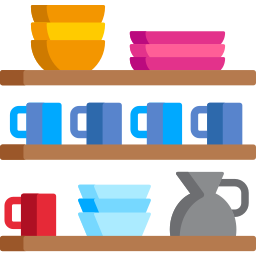
im Regal
on the shelf
Das Buch liegt im Regal.

der Stuhl
the chair
Du sitzt auf dem Stuhl.

auf den Stuhl
on the chair
Du setzt dich auf den Stuhl.

Setz dich bitte hin.
Please sit down.
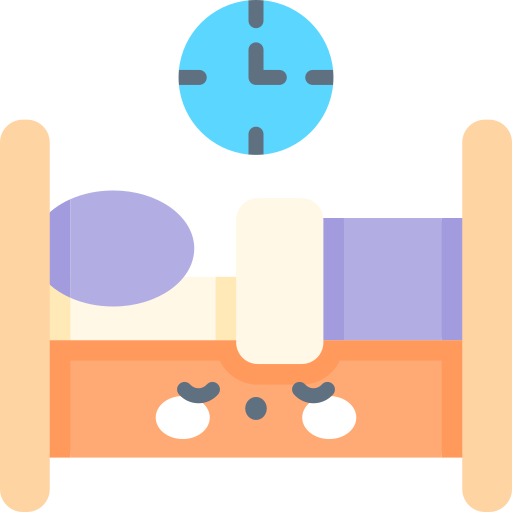
sich ins Bett legen
go to bed
Ich lege mich ins Bett und versuche einzuschlafen.

der Spiegel
the mirror
Er stellt den Spiegel an die Wand.

senkrecht
perpendicular
Die Flasche stellt senkrecht auf dem Tisch.

waagrecht
horizontal
Die Flasche liegt waagrecht auf dem Tisch.
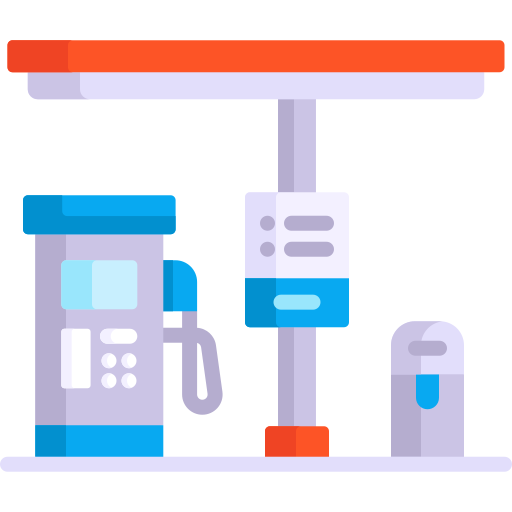
die Tankstelle
the petrol station
Wo ist die nächste tankstelle?
*Inside or outside?*
When someone or something is *inside*, it's "drinnen" and "draußen" means *outside.*
But it's not that simple! We use "herein" and "heraus" to indicate movement into or out of a place.
"Herein" means *in* or *into here*, and "heraus" means *out* or *out of here*.
"Rein" and "raus" are used to describe movement towards or away from a place.
drinnen
inside
Ich warte schon drinnen.

draußen
outside
Draußen scheint die Sonne.
heraus
out
Das Wasser fließt aus dem Rohr heraus.

Komm herein!
Come in!
Komm herein, die Tür ist offen!

stattfinden
to take place
Der Unterricht findet heute draußen statt.

Darf ich rein?
Can I come in?

rausgehen
to go out
Tom geht nie raus.

Ich warte draußen.
I'll wait outside.
Ich warte draußen auf dich.

einen Moment warten
wait a moment
Warten Sie einen Moment, ich komme raus.
*Verbs with fixed prepositions*
There are many different prepositions that can belong to verbs. It is very important that you learn prepositional verbs always in *verb + preposition* pairs. Some verbs can make pairs with more prepositions and then the meaning changes!
Let's look at the verb "sich freuen":
"sich freuen auf" = to look forward to
"sich freuen über" = to be happy about
"sich freuen für" = to be happy for

Ich freue mich für dich!
I am happy for you!

sich interessieren für
to be interested in
Interessierst du dich auch für Politik?

bestehen aus
to consist of
Die Prüfung besteht aus 4 Teilen.
warten auf
to wait for
Er wartet schon auf uns.

denken an
think of
Woran denkst du den ganzen Tag?

teilnehmen an
participate in
Wir nehmen an der Veranstaltung teil.

ausgeben für
spend for
Sie gibt viel Geld für neue Kleidung aus.

sprechen über
talk about
Worüber sprecht ihr?
*Can you close the window?*
Did you know that the verb "machen" can have multiple meanings when you add different prefixes to it? For example, the German verb "machen" with the prefix *auf* means *to open* and adding the prefix *zu* means *to close*.

aufmachen
to open
Kannst du bitte das Fenster aufmachen?

zumachen
to close
Mach bitte die Tür zu.

abmachen
take something off / to make (an appointment)
Lass uns einen neuen Termin abmachen.

Abgemacht!
Deal!
anmachen
to turn on
Kannst du bitte das Licht anmachen? Es ist schon dunkel.
ausmachen
to turn off
Du musst jetzt den Fernseher ausmachen.

Das macht mir nichts aus.
I don't mind.

nachmachen
to imitate / copy
Es ist nicht schwer. Ich zeige es dir und du kannst es dann nachmachen.

mitmachen
to participate
Was spielt ihr? Darf ich mitmachen?

Das macht spaß!
It's fun!
Deutsch macht spaß!
*Ordinal numbers*
You have already learned the German numbers from 1 to 10. Just like in English, the German numbers change their form when they are ordinal. The numbers 1, 3 and 7 are irregular but the rest is simple - just add an ending *-te*, for example: 2 - "zwei" - *der/die/das* "zweite"
1 - "eins" - *der/die/das* "erste"
3 - "drei" - *der/die/das* "dritte"
7 - "sieben" - *der/die/das* "siebte"
When you want to say *when* something happens, use the preposition "am" and add *-n* to the ordinal number:
"Mein Geburtstag ist am zehnten April."

die erste Stelle
the first place
Lerne, dich an die erste Stelle zu stellen.
die zweite Stufe
the second level
Er ist jetzt bereit für die zweite Stufe des Programms.

der fünfte Januar
the fifth of January
Heute ist der fünfte Januar.

Wann hast du Geburtstag?
When is your birthday?

am dritten
on the third
Ich bin am dritten März geboren.

der siebte Tag
the seventh day
Sonntag ist der siebte Tag der Woche.

meine erste Frage
my first question
Das ist meine erste Frage.

das Datum
the date
Welches Datum haben wir heute?

die erste Stunde
the first hour
Die erste Stunde im Deutschkurs.

Der Deutschkurs beginnt am sechsten.
The German course starts on the sixth.
Der Deutschkurs beginnt am sechsten Februar.
*I like your new dress!*
When you want to express that you like or disslike something, use the verb "gefallen". It goes with the Dativ so if you want to say that you like it, say: "Es gefällt mir."
"Gefällt dir das Kleid?" - "Ja, es gefällt mir sehr!"
"Geffalen dir die Bücher?" - "Nein, sie gefallen mir nicht."

Es gefällt mir.
I like it.

das Hemd
the shirt
Das Hemd gefällt mir.

die Jacke
the jacket
Gefällt dir die Jacke?
die Hose
the pants
Ihre Hose gefällt mir nicht.

der Pullover
the sweater
Mir gefällt der Pullover nicht.

die Brille
the glasses
Mir gefällt die Brille nicht so gut.

der Bikini
the bikini
Dein Bikini gefällt mir sehr.

Wie gefällt dir mein Kleid?
How do you like my dress?

Was gefällt dir in Deutschland?
What do you like about Germany?
der Gefallen
the favor
Kannst du mir einen Gefallen tun?
*What do you think about that?*
Now you know that you can use the verb "gefallen" to express that you like or disslike something. You can also use the word "gern" after a verb or the verb "mögen" (we've learned that in the first course).
The verb "finden" can also be used to say what you think about something:
"Wie findest du den Film?"
"Ich finde ihn sehr gut."
Another expression is "halten von":
"Was hältst du von dem Film?"
"Er gefällt mir nich to gut."

Wie findest du den Kurs?
What do you think of the course?

etwas besser finden
find something better
Ich finde Horrorfilme besser als Abenteuerfilme.

der Spielfilm
the movie
Ich liebe Spielfilme.

der Abenteuerfilm
the adventure movie
Magst du Abenteuerfilme?
bevorzugen
to prefer
Ich bevorzuge Komödien.
die Meinung
the opinion
Deine Meinung gefällt mir.

Was hältst du davon?
What do you think about it?

Gefällt es dir?
Do you like it?

Ich finde Deutsch toll!
I think German is great!