
IELTS - Preparation courseEnglish words
by DuoCards
*Welcome to the IELTS Mastery Course!*
We’ll cover *key vocabulary, grammar tenses, tips, and tricks* for high scores. The course begins with *speaking and writing*, focusing on *common mistakes*, followed by a *review of tenses* and *new vocabulary.* Grammar starts easy and gets more advanced.
*Let´s start with the speaking part.💭*
Think of it as a conversation - try to stay relaxed and natural.
It’s best to avoid memorized answers, as examiners can usually tell.
Try to speak a little every day, even if it’s just with yourself or an AI - it really makes a difference!
We’ve put together some handy phrases you can use to sound more fluent. Just be careful not to overuse them - balance is key.
*Best of luck!*

Let's roll!
When the movie was about to start, the director shouted, "Let's roll!

to kick things off
To kick things off, I would like to introduce our guest speaker.

on the flip side
I know that the weather is great for a picnic today, but on the flip side, it might be too hot for some people.
it goes without saying
It goes without saying that you should always wear a seatbelt while driving.
to sum up
To summarize, the report highlights the key findings of our research and provides recommendations for future action.
to put it differently
To put it differently, exercise is not just about physical health but also about mental well-being.
in a nutshell
To put it in a nutshell, we need to work harder to achieve our goals.

to draw a parallel
To draw a parallel, just as exercise strengthens the body, reading regularly strengthens the mind.

to play a crucial role in
Dedicated teachers play a crucial role in shaping the future of their students.
to put it simply
To put it simply, the project was a failure.
to delve deeper into this
To delve deeper into this, one must consider the long-term impacts of climate change on coastal communities.
Task 1 is more *introductory*. In task 2 you need to *express your thoughts* and perhaps *feelings*.
Let's see what phrases you could use:

in my opinion
In my opinion, this movie is really good.
on one hand, on the other hand
On one hand, online education offers flexibility and accessibility. On the other hand, it can lack the personal interaction that traditional classrooms provide.

I firmly believe that
I firmly believe that investing in healthcare infrastructure is vital for the well-being of a nation.

as far as I'm concerned
As far as I'm concerned, the best way to learn English is to practice speaking it every day.
for instance
I like to do outdoor activities, for instance, hiking and camping.

an emerging trend is
An emerging trend is the shift towards remote work, which has been accelerated by recent global events.
it's worth noting that
It's worth noting that bilingual individuals often have cognitive advantages over monolinguals.
striking a balance between
Striking a balance between work and leisure is essential for maintaining mental health and overall happiness.
Now, in part 3 of the speaking test, you need to be able to *talk about abstract ideas*. For this you can use *figurative language and idioms* to impress your examiners. But use only those you really know, if you make a mistake it will result in more deducted points.
down in the dumps
I've been feeling down in the dumps since I lost my job.
over the moon
I was over the moon when I found out I got the job.
lose track of time
I was so absorbed in my book that I lost track of time and missed my appointment.
look on the bright side
I know you didn't get the job you wanted, but look on the bright side - you have a lot of experience now and can apply for other positions.
not my cup of tea
I don't really like horror movies, they're not my cup of tea.
*Great job!* You have learned most common speaking phrases.
To build on that, I will give you a couple of more just to enhance your *coherence and communication skills* across all speaking tasks.
*Make sure to intentionally practice them untill it had become your second nature ^^*

I couldn't agree more
I couldn't agree more. We need to work together to find a solution.
to wrap things up
I'd like to thank everyone for coming today. To wrap things up, I just want to remind you of our next meeting date.
building on that
Building on that, we can see how technological advancements not only improve our daily lives but also open up new opportunities for innovation and growth in various industries.

to be well-off
My neighbor is well-off. He drives a luxury car and has a big house.
to be fed up
I'm fed up with this job. I need to find something new.
a hot potato
The issue of gun control is a hot potato in the United States.
in my personal experience
In my personal experience, studying abroad has greatly enhanced my understanding of different cultures and improved my language skills.
in light of these considerations
In light of these considerations, it is clear that stricter environmental regulations are necessary to combat climate change effectively.
to twist someone's arm
She didn't want to go to the party, but her friends twisted her arm.

without a shadow of doubt
Without a shadow of a doubt, investing in education is one of the best ways to ensure a prosperous future for our society.
One more thing, in speaking it is very important to use *hedging* language.
You can use hedging expressions to *express uncertainty* in your speech.
"It could be..."
"This might be..."
Beware of strong claims and statements about sensitive topics. Use hedgings to make your speech smoother and more sensitive.
It might well be that...
It might well be that the rise in remote work will lead to significant changes in how cities are designed in the future..
I am not sure but...
I am not sure but it seems that learning multiple languages can enhance cognitive abilities and cultural understanding.
As it seems that...
As it seems that climate change is accelerating, urgent action from all nations is required to mitigate its effects.
It might look...
It might look like a simple solution, but implementing renewable energy on a large scale involves complex planning and significant investment.
Now we need to address *most common mistakes in writing*.
In the writing you might come across *bar graphs* (graphs, diagrams and charts) which you will have to describe. Many people don't know how and unneccesarily lose points. *That won't be you!*
Here is some vocabulary to help you pass your writing tasks.

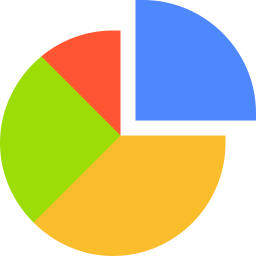
pie chart
A pie chart can be used to show the percentage of students in a class who prefer different types of music.
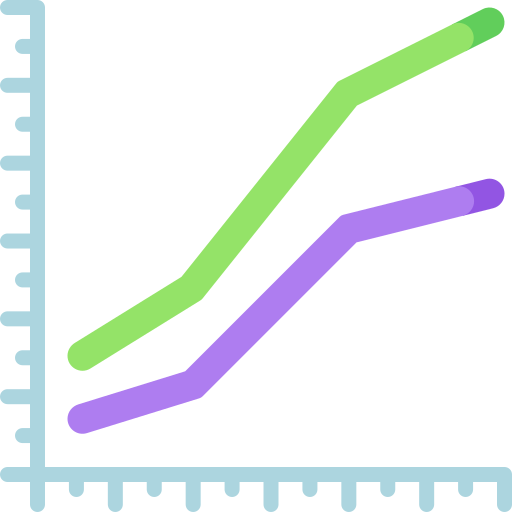
line graph
The line graph depicts the changes in unemployment rates over the last decade.

bar graph
The bar graph shows the population of five countries in 2020.

bar chart
A bar chart comparing the sales of different products in a store.
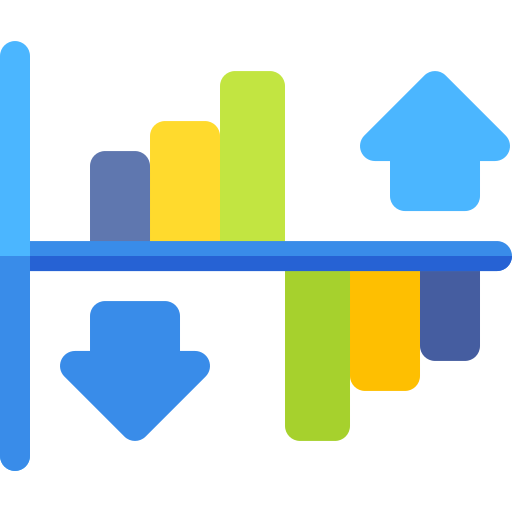
to compare
The data compare the performance of students in mathematics and science.

to imply
The results of the study imply that exercise can reduce stress.
to indicate
The data indicated a decrease in sales.
similar
The two graphs are very similar.
to illustrate
The graph illustrates the relationship between education level and income.

to depict
The chart depicts the annual rainfall in different regions.
from the graph it is clear
From the graph, it is clear that the majority of respondents prefer digital over print media.
Just a tip: if you want to write this: *%* in words.
The correct way is *per cent*
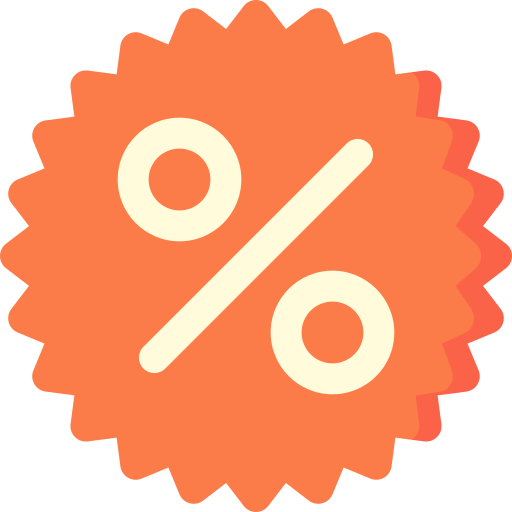
per cent
10 per cent increase
Try to be as *cohesive* as possible in your writing. Start a new paragraph for each new idea.
Always double check your spelling and grammar. Please do *answer the question fully*. Do not write about stuff you want to write about or just partially answer the question.
Write about what is required from you.
I will also give you *a few tips on punctuation* as many people do not know how to correctly use it.
English *punctuation* is different and sometimes it *can save lives!*
"Time to eat children. vs Time to eat, children."
Can you see what I mean here?
We also use commas before direct speech.
"She said, 'hurry up'!"
We also always need to use commas after phrases like however, nevertheless, to be honest, etc.
however
She is very talented. However, she lacks confidence.
nevertheless
I know it's raining. Nevertheless, I'm going for a walk.

to be honest
To be honest, I didn't like the movie.
firstly
Firstly, I would like to thank everyone for coming today.
first of all
First of all, let's discuss the main issues we need to address.

moreover
The hotel has a great location. Moreover, the staff is very friendly.
furthermore
I don't think we should go out tonight. Furthermore, it's supposed to rain.
conversely
Some people believe that money brings happiness. Conversely, others believe that money can't buy happiness.
*We can but don't have to use comma while talking about more things*.
"I like Eva, Marina, and Nicol." vs "I love cats, dogs and horses."
However, sometimes *it can be a little bit confusing* if you do not add the comma:
"I love my parents, Bill Gates and Pamela Anderson."
Unfortunatelly, Bill Gates and Pamela Anderson aren't my parents. Therefore, it is better to use comma between them as well.
to adhere
The tape adheres well to the wall.
antiquity
In antiquity, people relied on natural remedies and herbs for healing before the advent of modern medicine.
conscious
She was conscious throughout the surgery.
faulty
The engineer inspected the machine and found several issues: a faulty valve, a broken circuit, and a worn-out gear.
The final question: *When to use a comma between adjectives?*
We use commas between adjectives if we can use *and* instead of it:
"He is a nice and friendly man" -> "He is nice, friendly man."
But, *if we cannot use and between them, then there is no comma*:
"I adore delicious French croissants."
Here it would not make sense to say delicious and French croissants.

scrumptious
She cooked a scrumptious meal for us.

to purchase something
I need to purchase some new clothes for the party.

previous
The previous owner of the house left some furniture behind.
to attend
I will attend the school meeting tomorrow.
*Generally, do not use commas in front of but/and.*
"I want to swim in the ocean but I am terrified of sharks."
But we can use a comma *in case you want to make a pause*. In this case, you need to figure out where to put a comma based on your intuition.
"My best friend loves snakes, but not all of my friends like them."
We also use comma *when we change the subject of a sentence*:
"My teacher is very strict sometimes, but that's what I like about her."
Also, if you *start with a subordinate clause*, you also need to use comma, but we have already talked about that in conditionals.
"If you have time, call me."
to elucidate
Could you please elucidate your point? I'm not sure I understand.

to lament
He sat alone in his room, lamenting his decision to drop out of college.
inexhorable
The inexorable rise of global temperatures highlights the urgent need for action on climate change.

ephemeral
The beauty of cherry blossoms is ephemeral.
*Congrats! You have made it through the practical part. Now it's time for grammar!*
We are going to start *with present simple*, it is the most basic grammar, but even advanced English learners still make *mistakes in 3rd person singular or in questions*, please try to revise at least a little bit.
We use present simple for:
things that are *true in the present*: "I like ice cream"
something that happens *regularly*: "I play tennis every Sunday"
something that is *always true*: "Water boils at 100 degrees"
to suffer
He suffers from anxiety and depression.

The consistent increase in urban population density significantly enhances the demand for public transportation infrastructure.
to not mind doing something
I don't mind walking in the dark. I am not scared.
to research
I need to do some research for my history paper.
to be keen on
She is keen on learning new languages.
unless
I won't go to the party unless my friend comes with me.
*Beware of 3rd person singular!* Examiners will deduct points if you miss it.
he, she, it - likes, wants, does...
When we refer to animals, we use it.
We can use gender with animals only if we have a good relationship with them. "My dog is called Miky, I love him!"
Be careful with multuple people: "My mother and I are ..."

The advanced coating effectively shields the spacecraft from harmful cosmic radiation.
to rotate
The Earth rotates on its axis.
John and I are orphans.
to reflect
His behaviour reflects his true self.
to alleviate
The new policy alleviates the financial burden on low-income families.
*Questions:*
We use *do/does* in questions: "Do you play the piano? Does she like him?"
We also use it *with question words*: "Where do Anjela and Rita work? What time does he finish?"
*BUT! Questions with who do not use do/does*: "Who lives in London? Who plays football?"
species
Why do scientists classify different species of plants and animals?
What type of insecticide is most effective against aphids?

vast
What makes the Sahara Desert such a vast and inhospitable region?
swarm
What role does communication play in the behavior of a swarm?
proliferation
How does the proliferation of technology impact our daily lives?
to refute
How do you refute the claim that renewable energy sources are too costly to implement?
*Negatives:*
In speech we can use contractions; however, *in formal emails or essays, we have to use the long form.*
do not (long form) = don't (short form): "I don't like fast food."
does not = doesn't: "She doesn't want to come."

to rival
The new technology does not rival the efficiency of traditional methods.
to amplify
The small speaker doesn't amplify the sound enough for the large room.

male
He does not exhibit the typical characteristics associated with male behavior in the species.

ostentatious
He doesn't appreciate people who are ostentatious in their behavior.
Let's continue with *present continuous!*
We always need present tense of verb *be and the -ing* at the end of a verb.
We use it to talk about:
Activities happening *at the moment of speaking.*
to generate
The wind turbines are currently generating renewable energy for the entire region.
to become
The company is becoming a leader in renewable energy.
to outlast
He is outlasting all his competitors in the marathon.

ubiquitous
Smartphones are becoming ubiquitous, changing the way we communicate.
But we also use present continuous for *future plans and arrangements.*
When we know that something is *'100% planned' in the future.*
Somebody says 90%, somebody 99%...I dare to say 100% unless something tragic happens.

to hunt
They are going hunting next weekend.
Next week we are preparing survival kits for the camping trip.
to harm
She is advocating for policies that prevent chemicals from harming the environment.
among
Tensions are rising among the team members as the deadline approaches.
*We do not use continuous with stative verbs.*
Stative verbs of thinking and feeling: "believe, dislike, know, like, love, hate, prefer, realise, recognize, remember, suppose, think (believe), understand, want, and wish"
Stative verbs of senses: "appear, feel, look, seem, smell, sound, taste"
And other stative verbs: "agree, be, belong, disagree, need, owe, own, possess?"
to prefer
She prefers tea to coffee.

to suppose
I suppose we should leave now to avoid the traffic.
to owe
I owe you an explanation for my behavior.
to belong
These books belong to the library.
We also use present continuous to talk about something which is *happening before and after a specific time:*
"At eight o'clock we are usually having breakfast."
With something which *we think is temporary.*
"Michael is at university. He's studying history."
With something which is *new and contrasts with a previous state.*
"These days most people are using email instead of writing letters."
With something which is *changing, growing or developing.*
"The children are growing up quickly."

Michael is at university. He's studying history.

to roar
The crowd is roaring with excitement as the concert begins.
gullible
Even before the seminar, people are becoming more gullible, falling for obvious scams.
to persuade
I am working hard to persuade the committee before the deadline next Friday.
Present continuous is also used with something which *happens again and again (mostly with negative connotation - we normally use 'always'):*
"It's always raining in London."
He is always nitpicking at her and they are always arguing.

to inundate
She is always inundating us with unnecessary emails.
conundrum
He always finds himself facing the same conundrum of choosing between his career and personal life.

to adapt
We are always adapting our strategies to keep up with the rapidly changing market trends..
We can use present continuous to *talk about the past* when we are:
*Telling a story or summarising a book, film or play.*

The other day I'm just walking down the street when suddenly this man comes up to me and asks me to lend him some money.
Well, he's carrying a big stick and he looks a bit dangerous, so I'm wondering what to do …
Harry Potter is a pupil at Hogwarts school. One day when he is playing Quidditch he sees a strange object in the sky. He wonders what is happening …
Now it is time for *present perfect!*
We construe it with *subject + have/has + past participle.*
"I have intoruduced myself."
We use it to talk about things that *happened in the past but influence the present* and can, perhaps, continue to the future.
I have never caught a glimpse of that.
They have been pronounced husband and wife.

I have had my share of ups and downs.
I've just published this research I've carried out.

I haven't given up on him yet.
Let's have a look at the *difference between gone to and been to:*
gone to = the person is still away
been to = the person has experience from that place but had already returned"

She has gone to Belgium. She should return in December.

He has been to many exquisite places.
voracious
She has been to several book fairs, driven by her voracious appetite for reading.
to suggest
I suggest we go to the new Italian restaurant downtown; I've been to it once, and the food was amazing.
Now everyone's favourite *present perfect continuous.*
We form it by using *subject + have/has been + -ing*
We normally use this to emhasize that something is *still continuing in the present.*
We only use dynamic verbs with this grammatical tense.

She has been living in whimsical Africa since 1995.

I have been painting on this canvas all morning.
She is all sweaty. She has been climbing that oak tree.
They have been cutting down these damaged pine trees.
By the way, *we can use present perfect for future as well.*
Where we would normally use present simple, you can show off your great English skills and use present perfect instead:
"We will begin when everyone arrives."
vs
"We will gegin when everyone has arrived."
I'll keep on looking until I have found my book.

I will not stop until I have become the best leader.

ineffable
By the time they finish the project, the team will have created an ineffable masterpiece.

resilient
By next year, she will have become even more resilient in handling challenges.
anticipate
By the time the project is completed, we will have anticipated all potential challenges and addressed them accordingly.
We have checked present tenses, now it's time for the *past simple.* We use it to talk about:
- something that *happened in the past* - "I crashed my car into a bridge last week."
- something that *happened several times in the past* - "I made jokes about him each time I saw him."
- something that *was true for some time in the past* - "I lacked motivation for my exam, that's why it took me 3 attempts."
- we use expression *ago* in the past - "I met my wife 30 years ago."
In past simple we usually add *-ed to verbs*. But there are *irregular verbs* that need extra amount of time to master.
Let's start with those who differ in all three forms:
to bear (bore, borne)
to blow (blew, blown)
The strong wind blew the papers off the table.
to be (was/were, been)
She was the top performer in last night's talent show.
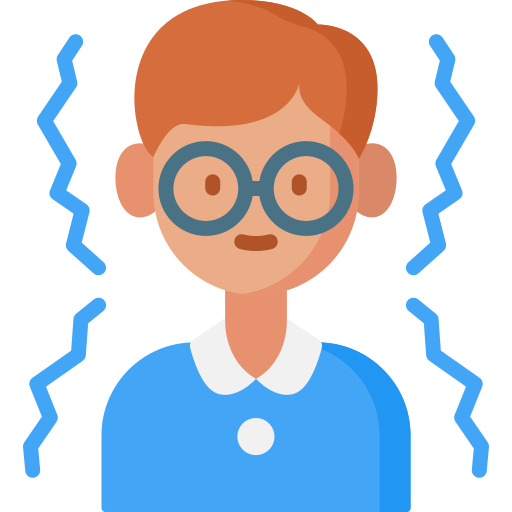
to shake (shook, shaken)
She shook the rug to remove the dust.
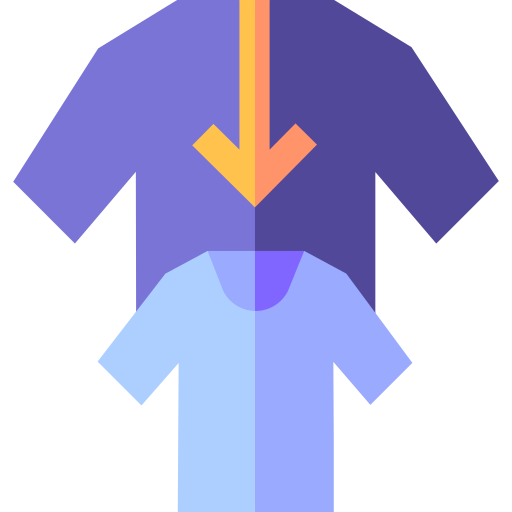
to shrink (shrank, shrunk)
The sweater shrank in the wash, so now it's too small for me to wear.
to tear (tore, torn)
I accidentally tore my shirt on a nail.
Now let's give some instances of those *irregular verbs with the same forms in the past tense and past participle:*
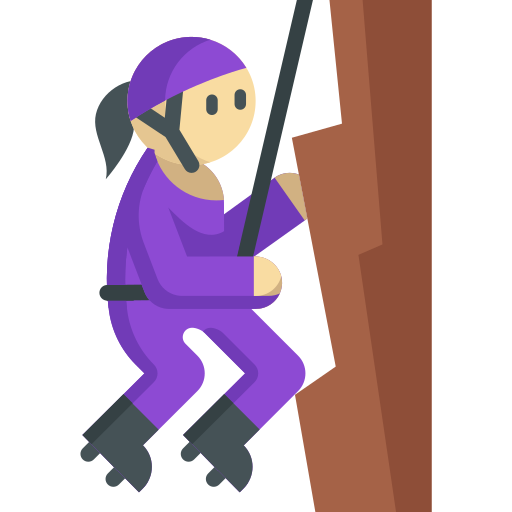
to creep (crept, crept)
I crept up the stairs so as not to wake the baby.
to cling (clung, clung)
The child clung to his mother's hand as they walked through the crowded mall.
to mean (meant, meant)
I meant to call you yesterday, but I got busy with work.

to seek (sought, sought)
She sought help from her friends.
to spin (span/spun, spun)
The dancer spun gracefully across the stage during her performance.

to sting (stung, stung)
The bee stung him on the arm while he was gardening.

to breed (bred, bred)
The farmers bred the cattle for increased milk production.
to light (lit, lit)
She lit the candles before the guests arrived.
to sweep (swept, swept)
She swept the leaves from the driveway.
to shoot (shot, shot)
The basketball player shot the ball into the hoop.
Then we also have all *3 forms unchanged:*
to upset (upset, upset)
The news upset him deeply, leaving him in a somber mood all day.

to bid (bid, bid)
She bid farewell to her friends as she left for her new job abroad.
And many people confuse the past tense and participle in verbs *to lie (to tell a lie), to lie (lying on a surface), and to lay (to lay down):*
to lie (lied, lied)
He lied about his whereabouts to avoid getting into trouble.

to lie on a surface (lay, lain)
The cat lay on the sunny windowsill all afternoon.
to lay (laid, laid)
She laid the baby down in the crib.
Many people forget that we can use past simple when reffering to present or future in hypotheses (when you imagine something)
"Imagine you won the lottery. What would you do?"
Imagine you encountered an ancient artifact. How perplexed would you be by its origins?
Now we are going to brush up on a tense that is not too commonly used. But it is often in tests and you can bump into it in real life too!
We use *past perfect simple (had + past participle)* to talk about *time up to a certain point in the past:*
"She had published her first book by the time she was ten."
We also use it *to show order of two past events.* The past perfect shows the earlier action and past simple the later action:
"When I got home I realized I had forgotten to buy groceries."
"Sadly, the author died before he'd finished the series."
We often use *already, still, just, ever, or never* with this tense.
"She was the most astonishing woman I had ever seen."

to scurry
By the time the storm hit, the mice had already scurried into their burrows.
to snuggle
The children had snuggled under the blankets before the power went out.
to neglect
She had neglected to water the plants for weeks, and they had all wilted.
By the time the final exam started, the sheer amount of material to review had already overwhelmed the students.
to testify
The witness had testified in court before the new evidence was discovered.
We use *past perfect continuous* for something which *started in the past and continued up to a given point in time:*
"When George died, he and Anne had been married for nearly fifty years."
or for something that *happened several times before a point in the past and continued after that point:*
"He was a wonderful guitarist. He had been playing ever since he was a teenager."
or when when we are *reporting our experience up to a point in the past:*
"My thirtieth birthday was the worst day I had ever had."
and just like with present perfect we use *for and since* with past perfect.

She had been working tirelessly for months, hoping that her efforts would eventually yield significant results.
to regard
He had been regarding her with suspicion long before the truth came out.

to sneak
They had been sneaking out of the house every night to meet their friends.

to meddle
She had been meddling in their affairs for months without their knowledge.
Now let's get into a tense that is called *future continuous (will/won't be + -ing).*
We use it to talk about *future actions that will be in progress at a specific time in the future:*
"When you come home, I'll be boarding a plane."
Or something we see as *new, different or temporary:*
"Today we're taking the bus but next week we'll be taking the train."
to extort
The corrupt officials will be extorting money from local businesses for protection.
to falter
The novice speaker will be faltering during his first big presentation.
to gauge
The scientist will be gauging the reactions of the participants in the experiment.

to grapple
The team will be grappling with the complex problem throughout the week.
The construction on the main road will be hindering traffic flow for the next few weeks.
For the future we also use *future perfect (will/won't have + past participle).* This tense is used when we talk about something that *will be completed before a specific time in the future.{
"Will you have gone to bed when I get back?"
We can use phrases like *by* or *by the time* (at some point before), *in* or *in a day's time/in two months' time/in five years' time* (at the end of the period) to give the time period in which the action will be completed.
"By the time I finish this course, I will have revised all English tenses."
"In three years' time, I'll have graduated from university."
to inhibit
By the end of the year, the new regulations will have inhibited further development in the area.
to lack
By the time the project is completed, we will have lacked the necessary resources to achieve the desired results.
to magnify
The telescope will have magnified the distant stars, making them visible to the naked eye.
to laugh
By the time the party is over, everyone will have laughed at the hilarious jokes and stories.
By the end of the year, the company will have abandoned its outdated policies in favor of more innovative practices.
to outline
By the end of the meeting, we will have outlined the entire project plan in detail.
We have now *revised all English tenses.* However, we have not revised how to combine them in certain situations...*under some conditions.*
I guess you can see where I am going. Now we are going to revise *conditionals* because many people make mistakes in them.
I bet you don't want to lose those precious points in your exam so let's get to work!
Practice makes perfect!
In English there are *4 main conditionals: zero, first, second, and third*...and then there are also *mixed conditionals*, but let's revise those 'easy' ones first.
Conditionals describe the *result of a certain condition.* The *if clause* tells you the *condition* and the *main clause* tells you the *result*.
"If you study hard, you will pass the exam."
The order of the clauses does not change the meaning. But beware of punctuation!
If I finish this course, I will be ready for the IELTS exam!
Zero conditional is just *fact based.* There is *present simple* tense on *both sides*:
"If you freeze water, it becomes solid."
*Beware of punctuation!* We use it *after* if clause but not before it!
"Water becomes solid if you freeze it."

to bestow
If you consistently demonstrate excellence, the organization bestows awards upon you.
to betray
If you betray someone's trust, they do not forgive you easily.

You circumvent many common issues if you follow the proper guidelines.

to confess
If you confess your mistakes, people appreciate your honesty.
to confine
If you confine your creativity, you do not reach your full potential.
*First conditional* is used for *future situations we believe are possible:*
"If it rains, we will stay at home."
*if/when clause + present simple, will + infinitive*
You can also bump into usages like *unless, as long as, as soon as,* or *in case* instead of *if*.
"I'll leave as soon as Lucy arrives."
"I don't want to do it unless you treat me with respect."
"I will show you to the kitchen in case you get hungry."
"You can call my sister as long as you stay just friends."
to deplore
If the company implements unfair policies, employees will deplore the management's decisions.
to invoke
If the situation becomes dire, the leader will invoke emergency powers.

If you don't handle the machinery carefully, it might maim you.
to grab
If you see a good opportunity, you will grab it without hesitation.
*Second conditional* is used for impossible situations that are *unlikely to happen:*
"If we moved to a bigger house, we could get another dog."
Structure: *if clause + past simple, would + infinitive*
When *if is followed by verb be*, it is grammatically correct to use it as *were*: "if I were, if she were."
Like this we can express that there is a *possibility under certain condition* and it comes from Old English.
However, you can commonly use and hear *if she/he was* and it is also *correct*.
"I wouldn't do that if I were you."
"If she was president, she would invest in education more."
"If he were a little nicer, I would consider him a good match."

If I were as nimble as a gymnast, I would join the acrobatics team.
to salivate
If you placed a delicious meal in front of him, he would start to salivate instantly.

to staple
If we ran out of staples, we would find it difficult to complete our reports efficiently.
to summarize
If we had more time, we could summarize the report in greater detail.
Now it is getting real or maybe...surreal? Let's get into *third conditional*. It is used to *imagine different past*. Usually when we *regret* something or would like to *change the past*...but it is *not possible*.
"If I had paid more attention, I wouldn't have to study as much."
Structure: *if + past perfect, would have + past participle*
If she had squeezed through the narrow gap, she would have reached the exit in time.
to suppress
If the government had suppressed the evidence, the truth would never have come to light.

to tweak
If she had tweaked the formula slightly, the experiment might have been successful.
to digest
If I had properly digested all the information, I would have understood the topic better.
to evaluate
If we had evaluated the risks more thoroughly, we would have avoided the project's major setbacks.
And now the 'final boss'. Yes, you have guessed it...*mixed conditionals*.
We can use them when we imagine a *past change with a result in the present or a present change with a result in the past*.
Do you feel like it does not make sense? Let's check out some examples:
"If I hadn't got the job in Tokyo, I wouldn't be with my current partner."
In this case we imagine how a change in the past would result in the present.
Structure: *if + past perfect, would + infinitive*
"It's really important. If it wasn't, I wouldn't have called you on your holiday."
Here the speaker explains how a change in the present situation would influence the change in the past.
Structure: *if + past simple, would have + past participle*
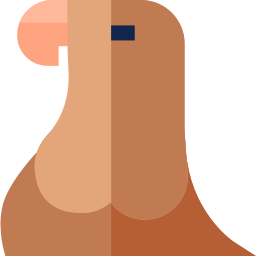
hawk
If he had studied ornithology, he would be able to identify that bird as a hawk now.

arduous
If she had not taken on such an arduous task, she would have more energy now.
If he had been more meticulous with his work, he would be enjoying a promotion right now.

If she were more proactive, her success would have been contingent on her hard work and dedication.
vibrant
If she were more outgoing, she would have made a vibrant speech at the conference last week.
This is *the end* of this course! I hope this helped you!
*Good luck with your IELTS!!!*

Break a leg!
I have a big audition tomorrow." "Break a leg!