Intermediate Korean Verbs and GrammarKorean words
by DuoCards
*Intermediate Korean Verbs and Grammar*
This chapter follows the Korean Numbers and Numeratives (in terms of difficulty) but does not necessarily require their knowledge. Here we will learn a bit about more difficult grammatical concepts, to help us make better sentences!
Let´s start!

이제 시작하자!
Let's get started!

배우기 전에 커피를 마셔요?
Do you drink coffee before learning?

한국어를 많이 공부한 후에 어떻게 쉬어요?
How do you relax after studying Korean a lot?

새로운 단어도 열심히 배울 거예요.
You will also learn new words diligently.

이제부터 문법이 좀 더 재미 있을 것 같아요.
I think the grammar will be a little more fun from now on.
*The Present Continuous Tense*
In Korean, we can describe a continuous state of activity with the "- 고 있다" grammar, which we simply add to the stem of an action verb (an activity!), and then we conjugate the 있다 at the end.
Sentences created with this grammar are similar to English sentences with verbs ending in *-ing*, e.q. *I'm currently working, let's talk later.*

하고 있다
To be doing

저는 지금 한국어를 배우고 있어요.
I am learning Korean now.

배우기 전에 아침을 먹고 있었어요.
I was having breakfast before learning.
한국어를 배우기 전에 영어를 배웠어요.

기숙사
dormitory

제 기숙사 친구가 아직도 잠을 자고 있어요.
My dorm friend is still sleeping.

그 다음에 이를 닦고 있을 거예요.
Then he'll be brushing his teeth.

우리 엄마가 청소하고 있어요.
My mom is cleaning.

아들이 게임을 하고 있어요.
My son is playing a game.

할아버지가 김밥을 먹고 있어요.
Grandpa is eating gimbap.
"Confirmation - 죠?"
The next grammar to learn is the confirmation verb ending "죠". We can compare sentences ending with "죠" to English sentences ending in *..., right?*, where we assume that the person we´re talking to should already know this information.
The grammar is added, again, to the stem of the verb, and can be used both in declarative, and interrogative types of sentences.

한국어를 잘 하죠?
You are good at Korean, right?

지금 버스를 기다리겠죠.
We will be waiting for the bus now.

내일도 수업이 있죠?
Do you have classes tomorrow too?

휴일
holiday

휴일이라서 학교에 안 가죠...
I don't go to school because it's a holiday...

저녁으로 김밥을 자주 먹죠?
You often eat gimbap for dinner, right?
그냥 가끔만 먹죠.
I only eat occasionally, you know.

깨끗하다
tidy / clean

어제 이미 집에서 깨끗하게 청소했죠.
I already cleaned the house yesterday.
*...And!*
The Korean "그리고", which can be also shortened to "-고", and added to the stem of a verb, can be used to express the word *and*, thus creating a compound sentence of more than one verb.
"그리고" is used at the beginning of a new sentence, however, where the second half of the compound sentence would otherwise be.
Let´s look at the two different forms in example sentences ahead!

저는 햄버거가 좋아요. 그리고 김밥도 좋아요.
I like hamburgers. And kimbap is good too.

운동한 후에 샤워하고 저녁을 먹어요.
After exercising, take a shower and have dinner.

학생들이 학교에서 공부하고 연습해요.
Students study and practice at school.

잠을 잘 자고 푹 쉬세요.
Sleep well and rest well.

구경하다
go sightseeing
한식
korean food
한식집에서 불고기를 시켰어요.

서울에서 구경을 많이 하세요. 그리고 한식을 많이 먹으세요.
Do a lot of sightseeing in Seoul. And eat a lot of Korean food.

엄마한테 선물을 받고 열어 주세요.
Receive a present from your mother and open it.

습도
Humidity

날씨가 추워요. 그리고 습도가 낮아요.
It is cold. And the humidity is low.

주문하다
to order

식당에서 스크린으로 주문하고 앉으세요.
Order on the screen at the restaurant and sit down.
*By, With, ...*
The following grammar is used to describe a means of activity - for example:
How did you travel? = *BY* train. How did you eat the food? = *WITH* chopsticks. etc.
It can also be used to describe what job someone currently has:
I work as a doctor = "저는 의사로 일해요.".
Here you only need to attach the grammar to the job name.
Let's better show ways to use this grammar in example sentences!

저는 선생님으로 일해요.
I work as a teacher.

젓가락
chopsticks
젓가락으로 밥을 먹는 법을 가르쳐 주세요.

한국 사람들이 보통은 김치를 젓가락으로 먹어요.
Koreans usually eat kimchi with chopsticks.

강사
instructor / lecturer

제 친구가 주말에 피트니스 강사로 일해요.
My friend works as a fitness instructor on the weekends.
서울에서 부산에 기차로 갈 수 있어요.
You can go to Busan from Seoul by train.

비행기로 가면 기차보다 더 비싸요.
If you go by plane, it is more expensive than by train.

제가 이 두 눈으로 다 봤어요.
I saw it with both of these eyes.

출퇴근하다
commute, go to work, leave work
매일 매일 지하철로 출퇴근해요.
I commute by subway every day.

제 남자친구로 가끔 꽃을 사야 해요.
As my boyfriend, you sometimes have to buy flowers.

손목시계
wrist watch

아버지한테 선물로 비싼 손목시계를 주었어요.
I gave my father an expensive watch as a gift.
*So..., therefore...!*
The word "그래서" can be used to form a compound sentence, where the first half is a reason for what has happened in the second half of the sentence.
It is most often used in a shortened version: "-서", which is attached to basically a conjugated version of the verb - the biggest difference with "그리고", which is added to the original stem unchanged.
For example:
"하다" > "해서"
"마시다" > "마셔서"
"가다" > "가서"

아침을 못 먹어서 지금 배고파요.
I didn't eat breakfast so I'm hungry now.

숙제가 많아요. 그래서 스트레스를 받아요.
I have a lot of homework. So I'm stressed out.

양복
suit

양복을 입어서 멋있어요.
It's cool to wear a suit.

이 사람이 너무 예뻐서 만나고 싶어요.
I want to meet this person because he is so pretty.

소주를 마셔서 취했어요.
I drank soju so now I am drunk.

돈이 필요해서 도와주세요.
I need money so help me out.

오늘 날씨가 추워서 옷을 많이 입어요.
The weather is cold today, so I wear a lot of clothes.
수학
math

수학을 많이 공부해서 피곤해요.
I'm tired from studying math a lot.

영화관
Movie Theaters

영화를 좋아해서 영화관에 자주 가요.
I like movies, so I often go to the cinema.
*Let's...!*
The grammar "자" can be added to the verb stem at the end of the sentence, making it into a suggestive sentence. A rough translation of the grammar "자" can be *Let's do .....(the verb)*. So naturally, it can only be used with action verbs to describe suggestions of activities.

오늘 같이 밥을 먹자!
Let's eat together today!

친구들과 도서관에서 공부하자!
Let's study at the library with friends!

식당에서 치킨 하고 맥주를 주문하자!
Let's order chicken and beer at the restaurant!

날씨가 좋아서 공원에서 소풍을 하자!
If the weather is nice, let's have a picnic in the park!
오늘 날씨가 좋아서 공원에서 소풍을 하자!

너무 배고파서 떡볶이를 요리하자!
I'm so hungry, let's cook tteokbokki!

곧 팔려서 빨리 영화표를 사자!
It sells out soon, so buy a movie ticket quickly!

길이 위험해서 천천히 가자!
The road is dangerous, so let's go slowly!

쿠키를 먹고 녹차를 마시자!
Let's eat cookies and drink green tea!

이번 시험이 중요해서 잘 해 보자!
This exam is important, so let's do well!
*Right? You should know!*
The ending grammar "-잖아요" can be attached to the verb stem to indicate, that the information you are saying should be obvious to the listener! The meaning we are trying to convey is something like *You know that ---- this happened/is this way, already!*
It is also possible to use this with past, or future conjugated forms of the verb,
like so: "하다" - "하잖아요" - "했잖아요" - "할 거잖아요", or "하겠잖아요"

저는 학교에 있잖아요.
You know that I'm at school

쓰레기
Garbage

쓰레기를 벌써 버렸잖아요...
I've already thrown out the trash...

계산하다
to pay for something

돈이 있어서 제가 계산 할 거잖아요.
I have money, so obviously I'll pay for it.
날씨가 더워서 제킷을 집에서 놓았잖아요.
The weather was hot, so I naturally left my jacket at home.

숙제를 많이 해서 언어를 잘 하잖아요.
You do a lot of homework, so of course you speak the language well.

시간이 있어서 만나고 싶잖아요.
I have the time, so obviously I want to meet up.

집중
Concentration
교실이 시끄러워서 집중을 못 하잖아요.
The classroom is noisy, so of course I can't concentrate.

주말이라서 엄마가 벌써 여행을 갔잖아요.
Since it was the weekend, my mom had already gone on a trip.
*Have to/Should!*
Our next task is learning how to express a need to do an activity, that someone has to (or should) do a task. This is done through the "아/어/여야 하다" grammar, which again is connected to the verb in a conjugated form, e.q.:
"하다" - "해야 하다"
"마시다" - "마셔야 하다"
"굽다" - "구워야 하다"
etc..
Afterward, all we need to do is conjugate the verb "하다" at the end into the wanted tense (or add additional grammar, as we wish).

방을 청소해야 해요.
You need to clean your room.

인사
Greetings

반친구한테 인사를 해야 하죠.
You have to say hello to your classmates.

아침에 이를 닦고 아침 식사를 해야 해요.
I have to brush my teeth in the morning and have breakfast.
근육
muscle

근육을 잘 얻으려면 잘 먹어야 해요.
You have to eat well to gain muscle.

친구들이 와서 파티를 준비해야 해요.
Friends will come, so we should prepare a party.
크리스마스에 선물을 사고 줘야 해요.
I have to buy and give presents for Christmas.

옛날
A long time ago

옛날에 자동차 회사에서 일해야 했어요.
Once upon a time, I had to work for a car company.
몸
body
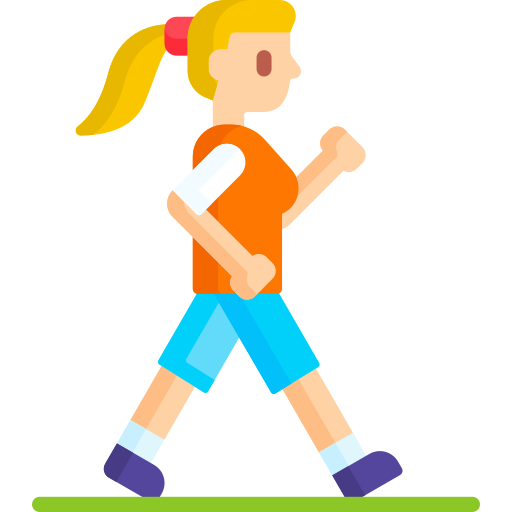
몸이 건강하려면 가끔 산책을 가야 해요.
I need to go for a walk once in a while to stay healthy.

대학교에서 더 열공해야 할 거예요.
You will have to work harder in university.

한국에 가면 비행기를 타야 해요.
When I go to Korea, I have to take a plane.
*If - condition*
The particle "-(으)면" indicates the if condition in a sentence, we can use it by attaching it to a verb stem in a sentence. The first clause describes the condition, the second clause describes the result.
e.q.: "가게에 가면 옷을 살 수 있어요."
If you go to the store, you can buy clothes.

가게에 가면 옷을 살 수 있어요.
If you go to the store, you can buy clothes.

벌
punishment

숙제를 안 하면 벌 받을 거예요.
If you don't do your homework, you will be punished.

사탕
candy

사탕을 너무 많이 먹으면 이가 나올 거예요.
If you eat too much candy, your teeth will come out.
돈을 충분히 벌면 어디든지 여행을 갈 수 있어요.
If you earn enough money, you can travel anywhere.

버티다
Withstand

운동하면서 음악을 들으면 버틸 수 있어요.
Listening to music while exercising can help.
매일 샤워를 하면 냄새가 안 날 거예요.
If you shower every day, you won't smell.

장갑
Gloves

눈이 오면 장갑을 껴야 해요.
When it snows, you must wear gloves.
시험을 잘 보면 100점을 받아요.
If you do well on the test, you get 100 points.

익숙해지다
To get accustomed to
새로운 직장에서 일하면서 조금씩 익숙해지고 있어요.

매운 음식을 자주 먹으면 점점 익숙새질 거예요.
If you eat spicy food often, you will get used to it.

교과서가 있으면 언어 배우기에 도움이 될 거예요.
If you have a textbook, it will help you learn the language.
*To be allowed*
The grammar -"도 되다" can be attached to a conjugated verb to form a sentence expressing *to be able to do something.* Then we must conjugate the verb "되다" into the appropriate tense.
The meaning contained in the grammar is similar to "*be allowed, be permitted, be able to,...*.

식당에서 음식을 주문해도 돼요.
You may order food at the restaurant.

도서관에서 조용히 공부해도 돼요.
You are allowed to study quietly in the library.

흡연
You are permitted to smoke in a smoking area.
저는 흡연하지 않아요.
질문
Question

학교에서 선생님한테 질문을 물어봐도 돼요.
You may ask the teacher questions at school.

교실에서 반친구와 말해도 돼요.
You are allowed to talk with your classmates in class.

과자
snack

쉬는 시간에 과자를 먹어도 돼요.
You can eat snacks during breaks.

이제 생일 선물을 열어도 돼요.
You may open the birthday present now.

드디어
finally
금요일까지 일해서 주말에 드디어 쉬어도 돼요.
I work until Friday, so I can finally rest on the weekend.

승진
You may get a promotion in the company.
저는 승진을 위해 열심히 일하고 있어요.
기숙사에 음식이 있어도 돼요.
You can have food in the dormitory.
*May not, not be allowed to, ...*
The grammar "(으)면 안 되다" can be used to form sentences expressing something is not allowed, forbidden, or preferred not to be done. We can simply attach the grammar (the same way as the particle -면) to a verb stem (of the not allowed activity), and afterward conjugate the verb "되다" at the end.

기숙사에서 요리하면 안 되었어요.
I couldn't cook in the dormitory.

도서관에서 음악을 크게 들으면 안 돼요.
You shouldn't listen to loud music in the library.

농담
joke

심각하다
It's a serious matter, so you can't joke about it.
이 문제는 심각해요.
하루 종일 운동하면 안 되잖아요.
You can't exercise all day.

저녁까지 잠을 자면 안 돼요.
You can't sleep until evening.

너무 더워서 물 없이 나가면 안 돼요.
It's too hot to go out without water.

비행기에서 전화하면 안 돼요.
You can't call on the plane.

양손으로 받다
In Korea, you have to receive money with both hands.

운전하다
drive

도시에서 차를 빨리 운전하면 안 돼요.
You can't drive your car fast in the city.
찜질방
Sauna
문신
In Japan, if you have a tattoo, you cannot go to a sauna.
문신을 하면 아플까요?
*Forbidden/Possible*
Another method of expression is by using the verb "금지되다", which means to be forbidden, or "가능하다", which means to be possible!
Let's practice using these verbs along with our grammars.
여기에는 음주가 금지되었어요.
Drinking is forbidden here.

음주
Drinking

예약
reservation

미리 예약하는 것이 가능해요.
It is possible to make a reservation in advance.

집 안에는 신발을 신기가 금지돼요.
It is forbidden to wear shoes inside the house.

승리
Victory

게임을 잘 하면 승리가 가능해요.
If you play well, victory is possible.

거리에서 쓰레기를 버리기는 금지돼요.
It is forbidden to throw garbage on the street.
*Recapitulation!*
That's it for this chapter, congratulations on learning 11 new grammars, let´s try on more example sentences for each of them before we close up!
The grammars were:
-고 있다
-죠?
그리고
-(으)로
그래서
-자!
-잖아요
-야 하다
-(으)면
-도 되다
-(으)면 안 되다
제 엄마는 잠을 자고 있어요. 조용히 가요.
My mom is sleeping. Go quietly.

조용히
quietly
유학생들이 독일어를 잘 하죠?
International students are good at German, right?

학교에서 열심히 연습하고 공부해요.
I practice and study hard at school.

집에 기차로 가요.
Go home by train

다이어트를 해서 샐러드를 먹을 거예요.
I will go on a diet and eat a salad.

시험을 본 후에 같이 밥을 먹자!
Let's eat together after taking the test!
날씨가 벌써 따뜻해졌잖아요.
The weather has already warmed up, don't you know?

공연
show

서울은 홍대에서 공연을 꼭 봐야 해요.
In Seoul, you must see a performance in Hongdae.

천천히
slowly
커피가 뜨거우면 천천히 마셔요.
If the coffee is hot, drink it slowly.
공항
airport

공항에서 사진을 찍으면 안 돼요.
You can't take photos at the airport.
*Good job!*
Thank you for your participation in the course, see you in the next one!

수고 했어요.
Great job.

이제는 한국어를 더 많이 이해해요?
Do you understand Korean more now?
단어 연습을 잊지 말자!
Don't forget to practice your vocabulary!
모르는 문법을 다시 봐야 해요!
You should look at the grammar you don't know!

다음 코스에 보자!
See you on the next course!