
Intermediate CourseEnglish words
by DuoCards
*Welcome to the Intermediate Course!*
This course will take you one step closer to feeling confident in English! We’ll learn how to compare adjectives, talk about the past, explore phrasal verbs and much more.
*But before we get to it, let’s warm up with a few useful words and phrases.*

fluency
Improving your fluency takes practice.

rewarding
Volunteering at the animal shelter is a rewarding experience.

achievement
He felt proud of his achievement when he finished the marathon.

English fluency is a great achievement.
skills
Learning new skills can be fun and rewarding.
She hopes to acquire new skills.

confident
Being confident can help you succeed.

challenging
Learning a new language can be challenging, but it is very rewarding.

knowledge
She has a lot of knowledge about animals and their habitats.

I get along with my coworkers.
She's slightly late.
He is working hard to get a raise.
overwhelming
The amount of homework was overwhelming for the students.
The workload became overwhelming.
I felt overwhelmed after the meeting.
*Phrasal Verbs*
Have you come across *phrasal verbs* already? Let's take a look at them together!
A phrasal verb is a phrase that has a *special meaning.* Phrasal verbs have *a main verb* and *another word* that is usually either an adverb or a preposition.
For example:
"to put on" means to get dressed
"to work out" means to exercise

to chill out
I'm just chilling out in front of the TV.
to figure out
Can you help me figure out this math problem?
I need to figure out how to fix my bike.
to put on
He put on his shoes quickly.
I put on my shoes before I go outside.
to turn on
I will turn on the TV to watch my favorite show.

to turn on a TV
After dinner, we usually turn on the TV to relax.

to turn off
I always turn off my computer before going to bed.
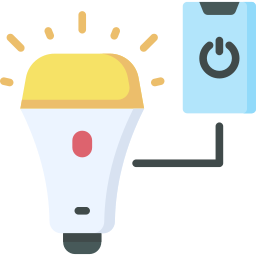
to turn off the lights
Before you leave the room, please turn off the lights.
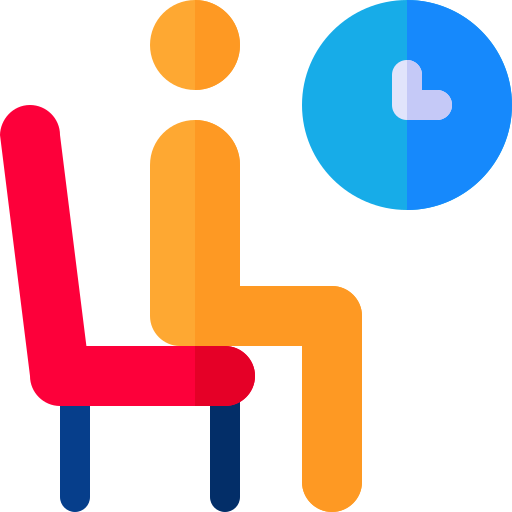
to sit down
Please sit down.

honestly
I honestly didn’t expect that to happen.

to come up with
I need to come up with a good idea for my project.

She came up with a solution.
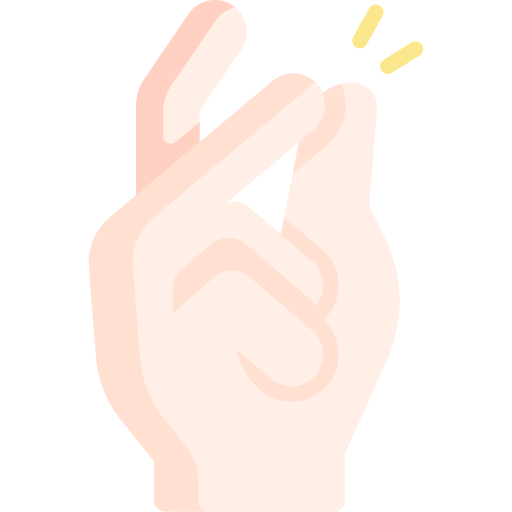
Take it easy.
Don't worry about the exam, just take it easy.

to cheer up
She knows how to cheer up the saddest person in the world.

Good music cheers me up.

Go ahead!
Can we start eating, mom? - Sure, go ahead.
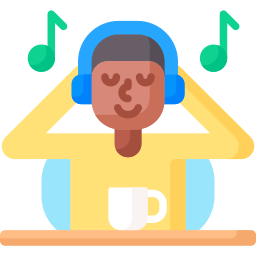
After work, I like to chill out and listen to music.

Keep it up!
Keep up the good work.
*Types of Adverbs for intermediate level*
Adverbs are structures that modify verbs, adjectives, phrases, and other adverbs. Let us examine some of the most common and useful adverbs below!
right now
I have to make a call right now!

perhaps
Perhaps we could invite Davide and her friends to the party.

remarkably
The athlete performed remarkably well in the competition.

bashfully
He was smiling bashfully.
He bashfully looked away when she smiled at him.

to smile bashfully
He is smiling bashfully.

carefully
They carefully examined the painting to see if it was an original.

Follow the instructions carefully.
It is not difficult to make, providing you follow the instructions carefully.

Drive carefully!

to be in love
We had fun and we were in love.

hopelessly in love
She's hopelessly in love with him.

unusually
It's unusually cold outside.

rarely
I rarely eat dessert after dinner.
completely
She was completely surprised by the party.
I completely forgot about the meeting today.
*Linking verbs*
Linking verbs are verbs that don’t show an action but rather *describe the subject.* While verbs like "walk" or "jump" represent an action, linking verbs like "be" or "seem" add more details to the subject, such as "he seems nice" or "she is an architect."

obvious
The answer to the question was obvious.

to appear
Smoke appeared on the horizon.

fur
The cat’s fur was silky.

You seem nice.
I just met you, but you seem nice.

This place looks like a mess!
I can't believe how messy your room is! This place looks like a mess!

to look great
Liz looks great today.

Keep calm and carry on.
I know you're nervous about the presentation, but just keep calm and carry on.
to remain
The old building remains standing despite the earthquake.
It remains the same.
Despite the challenges, our determination to succeed remains the same.

to be awake
I was awake but still sleepy when the sun came up.

Are you awake?
*Comparative adjectives with adverbs*
You can use adverbials such as "slightly", "much", "a lot" before a comparative adjective. That means you can be more subtle in the comparisons you can make.
"The prices are slightly higher than they were last year."
"Those who start early will have a much better chance of meeting their goals."
"The task is a lot easier than it sounds."
Notice that "much better" is followed by a *noun*, however, it can also stand on its own.

far more
Love is far more important than money.

not quite
Yet, it is not quite finished.
I'm sorry, but I don't quite understand what you mean by 'cultural diversity'.
I don't quite understand.
I'm sorry, but I don't quite understand what you mean by 'cultural diversity'.
slightly
The prices are slightly higher than they were last year.
slightly different interpretation
That is a slightly different interpretation.
Could you speak more slowly?

much more
People eat much more food than they should.

the least pleasant
He found the least pleasant part of the job to be the long hours.

much better chance
They have a much better chance of winning.

the best ever
Yesterday I had the best pizza I've ever eaten!
*Past simple*
As you already know, with most verbs, the past tense is formed by adding *–ed:*
"call" - "called"
"like" - "liked"
However, there are a lot of *irregular past tense forms* in English. You need to remember these.
"to get" - "got" - "gotten"
"to break" - "broke" - "broken"
"to bring" - "brought" - "brought"
"catch" - "caught" - "caught"
"to drive" - "drove" - "driven"
"to eat" - "ate" - "eaten"
"forget" - "forgot" - "forgotten"
"to think" - "thought" - "thought"
"to know" - "knew" - "known"
"to speak" - "spoke" - "spoken"
"to understand" - "understood" - "understood"
"forbid" - "forbade" - "forbidden"

I got a gift.
I got a gift from my best friend.
He got the message.
He got the message from you.

I was awake.
I was awake the whole night.

I brought you a gift.
I brought you a gift for your birthday.
He drove me to work.

We ate too much.

I forgot to reply to her email.

She drove through the storm without stopping.

I knew it!
I knew it! The restaurant is closed on Sundays.
The school forbade students to use their phones.

She spoke to him by phone.

I thought about it.
He caught me looking at his screen.
I understood.
She explained the concept to me, and I understood.
*The different uses of get*
The verb "get" can seem quite confusing for most English students. You can hear native speakers use it in almost every conversation.
The most common meanings of this verb are the following:
*1. Obtain/buy*
"I need to get some files from the archives."
"We must get some milk. There isn’t any left."
*2. Take*
"She gets the train to work every day."
"We can get a cab back to the hotel."
*3. Receive*
"Did you get my email yesterday?"
"She got a beautiful necklace for her birthday."
*4. Become*
"It’s getting colder. Put on your jacket."
"You can get better at English by practicing."
*5. Arrive*
"They left at 4:30 and got home at 5:30."
"When do you think you’ll get here?"
*6. Understand*
"I didn’t get what he said. Did you?"
"He got the joke but I didn’t."
*7. Make something happen*
"You should get your hair cut. It’s really long."
"We’re getting the car checked before our holiday."

Did you get it?

I didn't get the joke.
I didn't get the joke. Can you explain it to me?

to acquire
I need to acquire more information before making a decision.

Get it done.
Just get it done, please.
I got home at midnight.
I got home at midnight.

to get a cab
We can get a cab back to the hotel.

get better
You can get better at English by practicing.
It's getting cold.
It's getting cold outside.

Did you get my message?
Got it!

You can get better at English with DuoCards.
*Common phrasal verbs with get*
There are quite a few phrasal verbs with "get" that you already know and use without even thinking about it.
For example:
"What time do you get up?"
"Get up" means to leave your bed in the morning.
Let’s have a look at some of the most important phrasal verbs with *get*.

get on
Here’s the bus. Let’s get on.
Get on the train!
I always get nervous when I have to get on a crowded train.

to get off
We got off the plane and went to passport control.
to get in
He got in the car and put on his seatbelt.
to get out
Get out of my room!

to get back
We should get back by 7:30. Can you wait for us?

Get back immediately.
He told me to get back immediately after I finished my work.

to get over
I had flu last week but I’ve got over it now.
It took her months to get over the disappointment.
to get on / along with somebody
Do you get on with your colleagues?
Despite their differences, they got along well.
to get across
I tried to get my point across to the teacher, but she didn't seem to understand.

He struggled to get his point across.

to get away with (something)
He stole some money from the firm but no one found out so he got away with it.
You can't get away with it!
You can't get away with cheating on the test. The teacher will find out.
*Cause and Effect*
Let's look at some words and phrases that help you join two ideas together. We often use expressions such as "because", "since", "due to", "as", "thanks to", "therefore", "so" to talk about cause and effect.
Note, that there's a difference between "due to" and "thanks to".
*Thanks to* has a *positive connotation*.
*Due to* is more *neutral* - it can have both a negative and a positive connotation.

therefore
He was injured and therefore unable to play.

as a result
He didn’t work hard. As a result, he was fired.

due to
Due to the rain, the game was cancelled.
thanks to you
Thanks to you I was able to finish the homework.
to go out
Let's go out dancing!
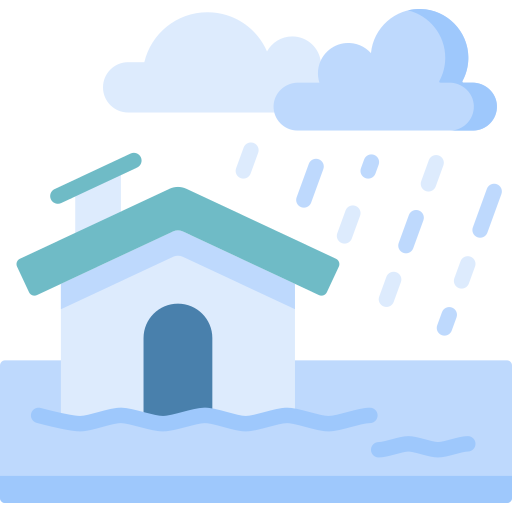
I can’t go out as it’s raining.

to get a raise
He is working hard in order to get a raise.

Thanks to his hard work, he got a raise.

since it's your birthday
Since it's your birthday, you got to be invited for lunch today.

because of
We cancelled the trip because of the rain.

I did it because of you.
*What comes after a verb?*
There are many verbs in English and there are many different patterns for what comes after a verb.
Some common patterns are:
*Verb + infinitive with to*
"I decided to take the car to work."
"He offered to cook dinner."
*Verb + -ing form*
"It took years but I've finally quit smoking."
"After she finished reading the book she turned off the light and went to sleep."
*Verb + (that) clause* (You can leave out "that".)
"I understand that you weren't happy with your pay rise."
"I suggest that you try the salmon, it's delicious."
I love learning new vocabulary!

to quit
I'm going to quit my job and travel the world.
to suggest
I suggest that you taste the salmon, it's delicious.
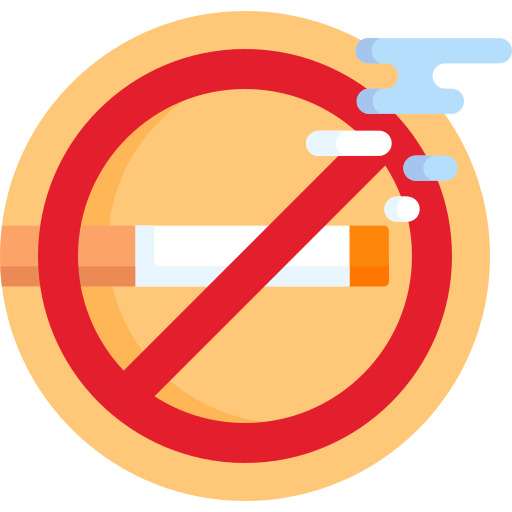
I suggest that you quit smoking.

He likes telling jokes.

pay rise
Sarah received a significant pay rise this year.
to assume
She assumed that I knew the answer.

I assume you're right.
to decide
I decided to tell her that I love her.
I decided to do it.
scattered
I understand that you are a bit scattered.
to be scattered
Why are they scattered?

to take care of (something/someone)
She offered to take care of it.
I have a lot of work to do this weekend, but my friend offered to take care of my dog while I'm busy.
She refused to admit that she had made a mistake.
to avoid
I try to avoid junk food to stay healthy.

He avoided answering the question.
We noticed that something was wrong.
*More rules*
Some verbs have different meanings depending on whether they are followed by an *-ing form* or *to + infinitive*.
For example:
"Stop" *+ -ing* means the action is *not happening anymore.*
"Stop" + *to + infinitive* means that someone or something stops an activity *so that they can do something else.*
"I've stopped buying the newspaper because now I read the news online."
"He stopped the video to ask the students some questions."
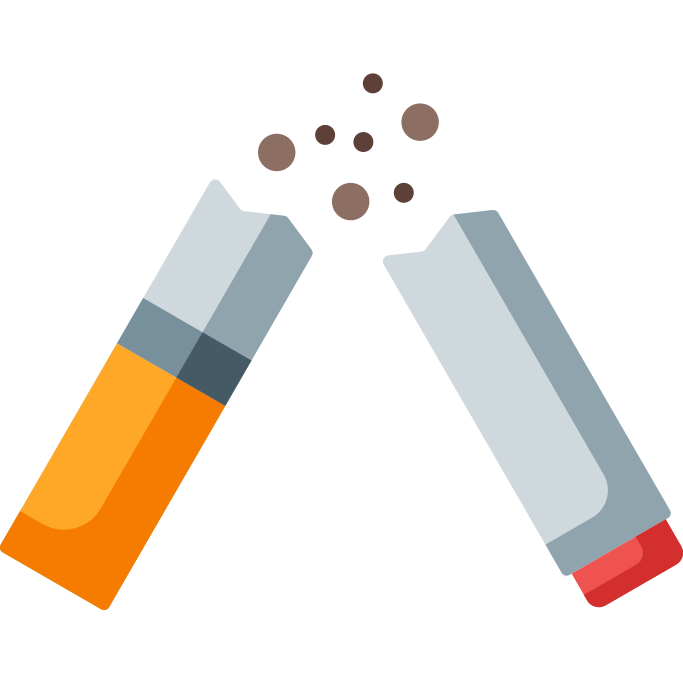
I stopped smoking.
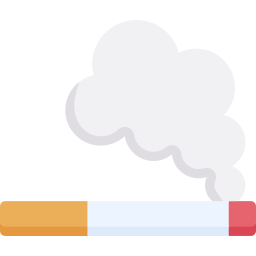
I stopped to smoke.
I was walking to work, but I stopped to smoke a cigarette.

to remember
I'll always remember this holiday.

I remember seeing him before.
I remember seeing him before, but I can't remember where.
Remember to call me.

to lock
He forgot to lock the car.

He forgot to lock the door.
He forgot to lock the door when he went out.

I remembered locking the door before leaving the house.

I remembered to lock the door before I left the house.

I'll never forget meeting you for the first time.
I'll never forget meeting you for the first time. You were wearing a bright red shirt and had the biggest smile on your face.
to reckon
I reckon it will take about an hour to get there.

I'm trying to
I'm trying to learn Japanese but it's very difficult.

Have you tried turning the computer off and on again?

outstanding
The view from the top of the mountain was outstanding.

What an outstanding performance!
*Hate, like, love, and prefer*
We can use *hate, like, love, and prefer* with an -ing form or with a to-infinitive.
In American English, the forms with to-infinitive are much more common than the -ing form.
There is a very small difference in meaning between the two forms. The *-ing form* emphasizes the *action or experience.* The *to-infinitive* gives more emphasis to the *results* of the action or event.
We often use the -ing form to suggest enjoyment (or lack of it), and the to-infinitive form to express habits or preferences.
The -ing form is more common than the to-infinitive form after *hate and love.*
When we use "would" with *hate, like, love, or prefer*, we use the *to-infinitive*, not the -ing form.
We would hate to see you go.
We really value your contributions to the team. We would hate to see you go.

I would love to be there!
Are you going to the concert tonight?" "I would love to be there, but I have to work.

for too long
Don't let me wait for too long.
They don’t like sitting for too long.

I like baking pizza.
I hate waiting.
He would hate to wait there for more than an hour.
to interrupt
She had to interrupt the meeting to answer an important phone call.
He hates being interrupted.
I prefer to work on tasks that have clear deadlines.
to cause a problem
They’d hate to cause a problem.

I prefer going out
I prefer going out than staying at home.

a tie
The man is wearing a tie.

he prefers not to wear a tie
He prefers not to wear a tie to work.

to join
They invited us to join them at their table.
We would love to join you.
It's a tie!
it's a tie for first place
*Transitive or intransitive*
Some verbs always need an object. These are called transitive verbs. Some verbs never have an object. These are called intransitive verbs.
Some verbs can be used *with an object (transitively)* or *without an object (intransitively).* Sometimes the meaning is the same.
For example: "Please bring coffee." - In this sentence, the verb "bring" is transitive; its object is coffee, the thing that is being brought.
"The sun is shining." - In this sentence, the verb "shine" is intransitive, it doesn't require an object for the sentence to make sense.

Did you enjoy the course?
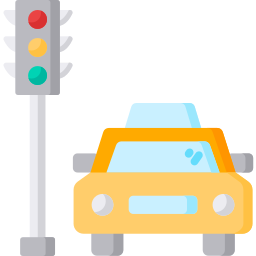
He stopped the car at the traffic lights.
(transitive)
The car stopped suddenly in the middle of the road.
(intransitive)

to emphasize
The book emphasises the role of the arts in society.

What happened?
Rita looks upset – do you know what happened?

Do not enter.

to enter the room
She entered the room looking nervous.

She learns to drive.
She learned to drive when she was twenty.

to drive a van
He drives a van for a delivery firm.

You should leave now.

He left me.
He left me without saying goodbye.
to save time
Buying things on the Internet saves people a lot of time.

Did you win?
How was the match? Did you win?

to win a competition
She won a competition and got a free trip to Copenhagen.

to increase
They increased my salary last month.
to get a car mended
i need to get my car mended
fluently
She speaks six languages fluently.
Imagine speaking English fluently.
*Say vs tell*
The most important difference between "say" and "tell" is that with "say", you don’t need to mention who the ideas or information were shared with, but with "tell", you do. For example:
"Amy said that she likes coffee."
"Amy told me that she likes coffee."

to tell the truth
We should always tell the truth.
to say something
Say something finally.

to say goodbye
They didn't even say goodbye.
I told you.
I told you so.
Nobody told me.
Nobody told me what to do.

Don't tell anyone.
Don't tell anyone your address or phone number.
She said it to me.
They told her to wait.
They told her to wait till the doctor arrived.
Can you tell me?
Can you tell me the truth?
He said he didn’t agree with the decision.

He told his manager that he didn’t agree with the decision.
*English can be exciting!*
Adjectives ending in *-ed* express how the *subject feels.* The subject himself has such a feeling, that something affects him. On the other hand, adjectives ending in *-ing* say that *the subject causes a given feeling in the environment* and that others feel that way because of it.
In other words, you can say:
"The teacher is boring." and "We are bored because of him."

That's exciting!
This is exciting news.

They were excited.
They were excited about the trip.

shocking
I heard the shocking news.
The news is shocking.
I was shocked by the news.
They were shocked by the news of the unexpected election results.
boring
I've got a boring job in an office.

to get bored
Maria gets bored easily.

It's interesting.
It's interesting that you didn't know that.
to be interested in
I am interested in football.

a surprising ending
The movie has a surprising ending.
I'm not surprised.
I'm not surprised by his behaviour.
The journey was exhausting.

They were exhausted after the journey.
worrying
She has a worrying habit of not sleeping well at night.
worried
She looked worried when she heard the news.
*Prepositional phrases*
A prepositional phrase is a group of words consisting of a *preposition, its object, and any words that modify the object.* Most of the time, a prepositional phrase modifies *a verb or a noun.*
For example:
"He arrived in time."
"Are you going by bicycle or on foot?"

by chance
I heard their secrets by chance.

on foot
If you go somewhere on foot, you walk there.

by all means
Can I borrow your car? - By all means!
at short notice
The meeting was cancelled at short notice.

at a glance
I know him at a glance.
to approve of
We’re not happy but we do approve of their decision.
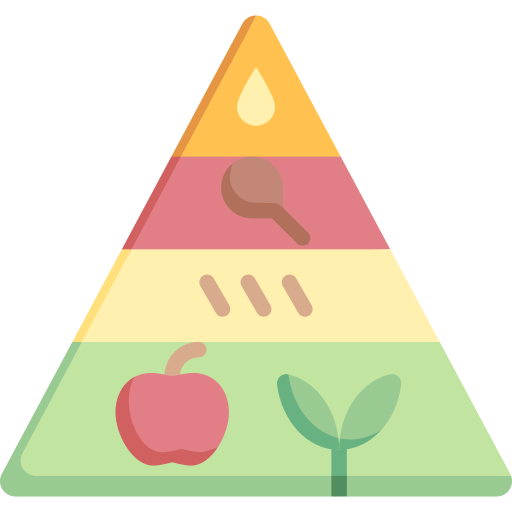
on a diet
The patient is on a diet.

around the world
Everyone around the world likes Coke.

to look forward to
I am looking forward to seeing you.

I am looking forward to seeing you.
in spite of
In spite of his fear, he decided to try skydiving.

In spite of the rain, we went hiking.

apart from
Apart from his job, he enjoys painting in his free time.

Apart from one mistake, the work was excellent.
*Should*
"Should" is a modal auxiliary verb. We use it mainly to:
give advice or make recommendations: "You should get a haircut."
talk about probability and expectation: "They should arrive soon."
talk about obligation: "You should be wearing your seat belt."

You should study.
You should study for the exam.

Should I come back?

to get a haircut
You should get a haircut.

You should be more careful.

What should I wear?
the weight
She should gain some weight.
to lose weight
You should try to lose weight.
to apply for a job
She should apply for the job.
It should be fine.

Should we study?
Should we study more?

Students should submit their work on time.

The system should update after restart.

I should be studying instead of scrolling.

They should have warned us about the changes.
*Like or as?*
"As" and "like" are often confused since they can both be used for *comparisons.*
Most of the time, like compares two things.
"He looks like my brother."
Frequently, as can be replaced by "the way".
"He can’t play cricket as he used to." ("He can't play cricket the way he used to.")

like me
You are just like me.
as much as
She loves curry as much as I do.
the same as
Your phone is the same as mine.

She looks like her mother.
the cotton
She doesn't wear cotton in the winter.

It feels like cotton.

to feel like
I don't feel like it.

to work as
I worked as an actor for two years.
She's like a sister to me.

people like us
There are lots of people like us.

to expect
As we expected, it started to rain.
as I said
As I said, I think this project will be a challenge.

The situation unfolded as we had predicted.

to unfold
As the story unfolded, we learned more about the characters' secrets.

Do it as instructed, otherwise it won’t work.
It seems like we’ve met before.
The room smells like something has been burning.
*Wishes about the present or future*
We can use "to wish" to talk about something that we would like to be different in the present or the future. We use *wish + past simple*:
"I wish I spoke Italian."
"I wish you were here."
"I wish I had a big car."

to wish
I wish you to quit smoking

I wish you were here.

to convince
I wish I convinced the judge.
bilingual
I wish I was bilingual.

I wish it was easy.
polite
I wish you were polite.
I wish I knew.
to translate
I wish they translated it.
I wish it was the weekend.

I wish I spoke fluently.
She wishes she had more free time.

He wishes he had grown up in a bilingual environment.
I wish I could become fluent.
effortlessly
She danced effortlessly across the stage.
I wish I understood native speakers effortlessly.