Elementary JapaneseJapanese words
by DuoCards
*Welcome to the Elementary Japanese course!*
Do you want to learn *basic phrases* and *grammar*?
Japanese is a very complex language. It is good to study it step by step to understand how the whole language structure works.
In this course, we introduce *Greetings*, *Basic sentence structure*, how to *ask for things*, and how to *make suggestions*.
*Greetings*
Do you know how to say *Hello* or *Good morning* in Japanese?
Let's learn basic greetings for everyday communication!
In Japanese, we call them "あいさつ" - *aisatsu* which means greeting.

おはようございます
Good morning
おはようございます、先生。

こんにちは
Hello
こんにちは、元気ですか?

にち
Day, sun
今日は日曜日です。

こんばんは
Good evening
こんばんは、今日はいい天気ですね。
こんばん
This evening
こんばんのパーティーは楽しみです。

さようなら
Goodbye
先生が授業の終わりにさようならと言いました。

すみません
Excuse me
すみません、お名前は何ですか?

ごめんなさい
Sorry
ごめんなさい、遅れました。

ありがとうございます
Thank you
プレゼントをもらって、ありがとうございます。

いらっしゃいませ
Welcome (f.e. to a store)
いらっしゃいませ!何かお探しですか?

またね
See you
明日学校で会おうね。またね!

ようこそ
Welcome (to Japan)
日本へようこそ
*See you!*
In Japanese, there are special phrases we use when leaving or entering:
"いってきます" literally means *I will go and come back*. It consists of two verb "いく" *go* and "くる" *come*.
The literal meaning of "いってらっしゃい" is *Please go and come*. This is a response to *Off I go*.
We use "しつれいします" when entering or leaving a place (e.g. an office). We can also use it when we end a phone call. Literally, it means *Excuse me*.
There is a special phrase we use before and after meals as well:
We use "いただきます" before eating. "いただく" is a humble form of *to receive*.
After the meal, you say "ごちそうさまでした" to show appreciation towards the person who prepared the dish for you and the meal you ate.

いってきます
See you
お母さん、いってきます!
いってらっしゃい
See you later (please go and come back)

バイバイ
Bye-bye

ただいま
I'm back
ただいま、帰りました!

おかえりなさい
Welcome back
おかえりなさい!今日はどうでしたか?

しつれいします
Excuse me (when arriving or leaving)
失礼しますが、お名前をお聞きしてもよろしいでしょうか?

いただきます
Let's eat

ごちそうさまでした
Thank you for the meal (after eating)
*Nice to meet you!*
Let's learn some basic phrases for self-introduction!
In Japanese, it is called "じこしょうかい".
We always use "はじめまして" at the beginning before we start introducing ourselves. Literally, it means *Let me introduce myself*.
We say "よろしくおねがいします" after finishing our self-introduction. Do not forget it, otherwise, your communication partner will be still waiting to hear more from you :)
Depending on the situation "よろしくおねがいします" can be also used when asking someone (for help, a favor, etc).

初めまして
Nice to meet you
はじめまして、エステールです。どうぞよろしくお願いします。

たかしです
I am Takashi

チェコ人
Czech (person)
おじいさんはチェコ人です。
日本人です
I'm Japanese.
友達は日本人です。

べんごし
Lawyer
彼は弁護士です。

がくせい
Student
私はがくせいです。

はたち
20 years old
彼ははたちです。
36さいです
I'm 36 years old.
彼女は36さいです。

よろしくおねがいします
Nice to meet you.
初めまして、田中です。よろしくおねがいします。
*How do I make a sentence?*
Let's look at the basic sentence structure.
Sentences like *I am Japanese*, *It is 9:00* or *My brother is at high school* will be translated into Japanese using the desired noun and the word "です" which can be translated as (it) *is*.
*!* In Japanese, *verbs* are always at the end of the sentence *!*
Note that many sentences in Japanese do not have a subject. Subjects can be omitted whenever it is clear to the speaker *what* or *who* they are referring to.

です
(It) is
今日はいい天気です。
学生です
(I) am a student.
私は学生です。

せんせい
Teacher
私のせんせいはとても優しいです。

ドイツじんです
I am German
お父さんはドイツ人です。

金曜日です
It is Friday
今日は金曜日です。

がっこう
School
がっこうは9時に始まります。

アメリカ人
American
彼はアメリカ人です。
8歳です
(I) am 8 years old
彼は8歳です。
月曜日
Monday
私は月曜日に友達と遊びます。

9時です
(It) is 9 o'clock.
今は9時です。
*Introducing a topic*
If we want to specify what or who we are talking about, we attach the particle "は" *wa* behind the word or phrase we want to talk about. Particle *wa* indicates a *topic*.
We will learn about *particles* later but in general, *particles* are attached to words or phrases and indicate how these phrases relate to the rest of the sentence.
We always give a few example sentences but feel free to make your own with the words you know! :)
父は教師です
My dad is a teacher
お母さん
Mom
お母さんが好きな花は何ですか?

かわいい
cute
赤ちゃんはいつもかわいいです。

友達はチェコじんです
My friends are Czechs
せんこう
My major is Japanese
私のせんこうは日本語です。

しゅっしん
Origin
私は東京の出身です。

弟は10歳です
My little brother is 10 years old
弟はサッカーが好きです。

はずかしい
Embarrassing, shy
うちの猫ははずかしいです。

日本はきれいです
Japan is beautiful.
*Questions*
Let's learn how to make a question! It is very easy since you already know how to make sentences with "です".
Here we will learn a new particle "か" *ka*. To make a question you just add *ka* at the end of a sentence. See? I told you, it's easy! :)
You can extend your questions with a *question word* "なん" (what).
Try to answer these questions!

アメリカじんですか
Are you American?

がくせいですか
Are you a student?

だれ
Who
あの人はだれですか?
いくつですか
How old are you?

なに
What
なんですか

名前は何ですか
What is your name?

仕事は何ですか
What is your job?
どこ
Where
トイレはどこですか?

なんじんですか
What is your nationality?
母はなんじんですか
What nationality is your mother?
なんさいですか
How old are you?

さむい
Cold
さむいですか?

いもうとはなんさいですか
How old is your little sister?
なんじですか
What is the time?

だいじょうぶ
All right
大丈夫ですか?

ロンドンはなんじですか
What is the time in London?
*Possessive and connective particle*
Let's learn new particles!
Particle "の" - *No* connects two nouns. It can act like a possessive, showing ownership, and more generally, as a way to turn any noun into a modifier. Particle "の" is very versatile.
Particle "と" has two functions:
One is to connect two nouns meaning *and*.
Second means *with*.
See the example sentences to explore other alternatives.

あやこさんの名前
Ayako's name.
こども
Child

私の車
My car

大学の先生
A college professor

本
Book
日本語の本がありますか?

日本語の先生
Teacher of Japanese language
フランス語
French
私はフランス語を勉強しています。

にほんのだいがく
Japanese university

ともだちのお父さんはイギリスじんです
My friend's father is British

と
With, and

母と父
Mother and father, mother with father

びょういん
Hospital
病院と学校のあいだです。
英語と日本語を話します
Speaks English and Japanese.

アパート
Apartment
アパートの前です。
京都と東京に行きました
I went to Kyoto and Tokyo.
*May I?*
When asking for something, there are two possibilities with the same meaning.
1. "(を) ください"
2. "(を) おねがいします"
They both mean *Please* or *May I*.
When giving something you say "(を) どうぞ" *There you go*
We also included some phrases of how to say that you did or did not understand.

水をください
I'd like some water, please.

寿司をお願いします
Sushi, please.

かくにん
Confirmation
ご確認ください。

メール
Email
メールをご確認ください。

れんらく
Contact
連絡をお願いします
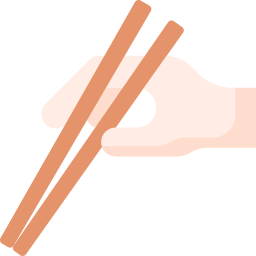
おはしをお願いできますか
May I have the chopsticks, please?

もう一度言ってください
Please say it again

はい、どうぞ
Here you go.
お茶をどうぞ。
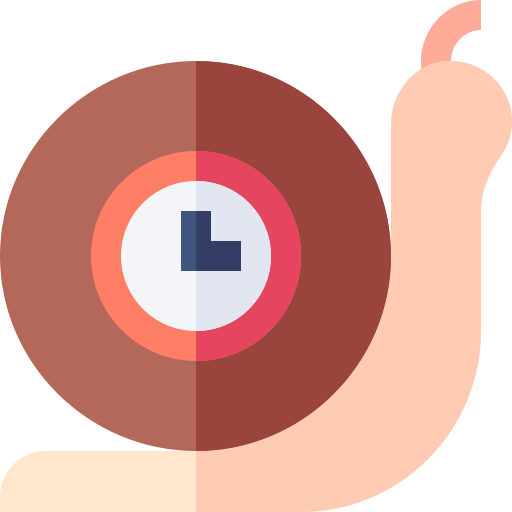
ゆっくり言ってください
Please say it slowly.
ちょっと待ってください
Wait a minute, please

分かりました
Understood.

メニュー
menu
このレストランのメニューはとてもおいしそうです。
分かりましたか
Did you understand?

チェックイン
check-in
チェックインをお願いします。
ちょっと、分かりません
I do not get it.
*Pointing words*
How to say *this*, *that*, *here* or *there*? Let's look at it together!
First, we introduce *pointing words* that we use when talking about things that we don't know the names of:
"これ" *this thing here*, meaning a thing that is close to you
"それ" *that one*, meaning a thing that is close to the communication partner
"あれ" *that one over there*, a thing that is neither close to the speaker nor the listener
"どれ" *which*
If we want to be more specific, we can use "この", "その" and "あの".
Unlike *kore*, *sore* and *are* which always stand alone, these words have to be followed by a noun!
The logic is the same for *here*, *there* and *over there*:
"ここ" *here*
"そこ" *there*
"あそこ" *over there*
"どこ" *where*

これはいくらですか
How much is this?

どれですか
Which one is it?

さいふ
Wallet
これはさいふです

レストラン
Restaurant
このレストランはとてもおいしいです。

かばん
Bag
それはかばんです

あれは傘です。
That thing over there is an umbrella.
あれは私の傘です。

それはわたしのペンです
That's my pen.
それはわたしの友達です。

ひと
Human
あのひとは先生です。

あれはお父さんの会社です。
That's your father's company!
あれはお母さんの家です。

このかさはいくらですか
How much is this umbrella?
このりんごはいくらですか
そのかばんはさんぜんえんです。
That bag is 3000 yen.
そのかばんはたかいです。

あのはなはきれいです。
That flower over there is beautiful.
あの海はきれいです。
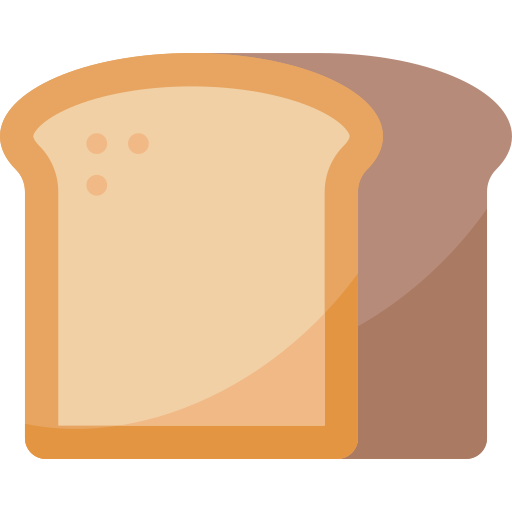
パン
Bread
このパンはたかいです。
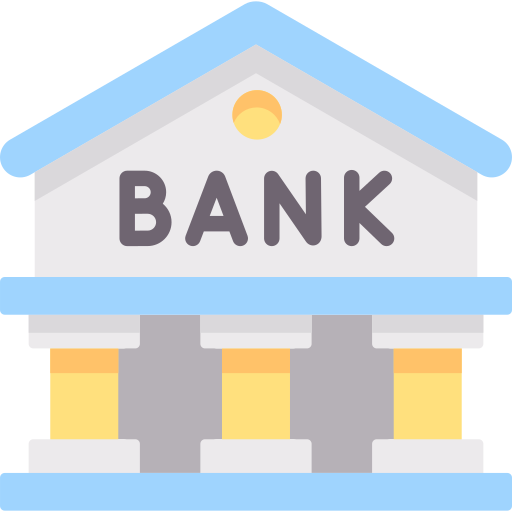
ぎんこうはどこですか
Where is the bank?

ゆうびんきょくはここです
Post office is here.
ゆうびんきょくはどこですか?
だいがくはそこです。
The university is there.
公園はそこです。

カフェはあそこです
The café is over there.
図書館はあそこです。

スーパーはどこですか
Where is the supermarket?
この近くにスーパーはどこですか?
*Me too*
Time for another particle!
Particle "も" means *too*.
It indicates, that that item or person, *too*, has the given property. We use it instead of the particle "は".
Let's have a look at some examples!

も
too

はなこさんもにほんじんです。
Ms. Hanako is also Japanese.
ジュース
juice
ジュースも飲みます。

お店
The shop
このお店も人気があります。

きらい
hate
コーラもきらいです。

ひなたさんも22さいです。
Hinata is also 22 years old.

さかな
Fish
さかなもたべます。
これもやさいです。
This is also vegetable.

アイスクリーム
ice cream
アイスクリームも買います。
にく
Meat
お肉も好きです

みちこさんもがくせいです。
Michiko-san is also a student.
*Negation*
We learned how to say (it) *is* by using "です".
To negate a statement we use "ではありません" instead of "です" at the end of a sentence. Another alternative is じゃありません.
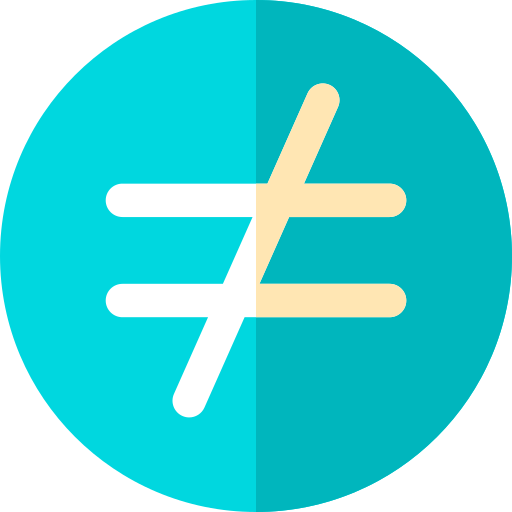
ではありません
Is not

えいが
Eiga
これは日本の映画ではありません。

たなかさんはせんせいではありません
Mr Tanaka is not a teacher.

デート
Date
違います、これはデートではありません。

しゅうまつ
Shumatsu
週末ではありません。

あそこはコンビニではありません
That's not a convenience store.

いえ
House
私のいえではありません。

やまださんはがいこくじんじゃありません
Mr. Yamada is not a foreigner.

アイデア
Idea.
いいアイデアではありません。

このTシャツは200えんじゃありません
This T-shirt is not 200 yen.
*Verb conjugation - Present tense*
Here we learn how to conjugate Japanese verbs.
Is it important to keep in mind that there are *two categories* of verbs that follow regular conjugation patterns. *Ru-verbs* and *u-verbs*. It is important to distinguish between them!
First, let's have a look at *ru-verbs*:
An example verb can be "みる" *miru* (dictionary form).
We call them *ru-verbs* because you add the suffix *ru* to the verb base (*mi*, in the above example) to form the dictionary form.
To make a *present-tense affirmative* form, we add the suffix "ます" *masu* to the verb base. *Mi-ru* = *Mi-masu*
To make the *present-tense negative* form, we add the suffix "ません" *masen* to the verb base. *Mi-ru* = *Mi-masen*
The second category are *U-verbs* - verbs that end with *u*:
They are a bit trickier because you add an extra vowel *i* when you conjugate them. But do not worry, we will show you how to do it!
The dictionary form of an *u-verb* like のむ *nomu* can be broken down into the base (*nom*) and the suffix *u*.
The long forms like "のみます" and "のみません", then, are formed with the base form plus suffixes *imasu* and *imasen*.
Try to make an affirmative or negative from the given verbs!
In Japanese, there are two *irregular verbs*:
"する" *Affirmative* is "します", *negative* is "しません"
"くる" *Affirmative* is "きます", *negative* is "きません"
見ます
(I) see
映画を見ます。
まいにち
Everyday
まいにち、学校に行きます。

にちようび
Sunday
日曜日に友達と遊びます。

見ません
(I) don't see
テレビを見ません。
食べます
(I) eat
毎朝、朝ごはんを食べます。

食べません
I don't eat
私は肉を食べません。

しごと
Work
今日は仕事しません。

寝ます
(I) Sleep
毎晩10時に寝ます。

寝ません
I don't sleep.
今日は早く寝ません。

起きます
(I) wake up
彼は遅く起きます。
起きません
I do not wake up.
6時に起きません。
飲みます
(I) drink
お茶を飲みます。

行きません
I do not go.
今日は学校に行きません。

話します
(I) talk
日本語を話します。

読みません
I don't read
本を読みません。
聞きます
I listen
音楽を聞きます。

帰りません
I will not return
明日も帰りません。

会います
I meet
来週、家族に会います。

しゃしん
Photo
写真をとります。

おもやげ
Souvenir
お土産をもらいました。

待ちません
I don't wait.
もう待ちません。

買います
(I) buy
お菓子を買います。

します
(I) do
スポーツをします。
来ます
I come
パーティーに来ますか?
*Particles of movement, time, direct objects, and place*
Let's learn more particles so we can build sentences with the verbs we learned!
Nouns used in sentences generally must be followed by particles, which indicate the relations that the nouns bear to the verbs.
Particle "で" indicates * where* the event described by the verb takes place.
Particle "に" has many meanings. Here we will learn it as:
1) a goal toward which things move
2) the time at which an event takes place
Particle "へ" indicates the *goal of movement*. It can be replaced with "に" and vice-versa.
Particle "を" indicates *direct objects*, the kind of things that are directly involved in, or affected by, the event.

がっこうでべんきょうします
(I) study at school

中国
China
もう中国に帰りません。
しごとにいきます
I go to work.

かのじょ
Kajo
明日もかのじょに会いません。

みずをのみます
I drink water

家にかえります
I will return home.

オフィス
office
新しいオフィスで働いています。

おんがくを聞きます
I listen to music.

テレビを見ません
I don't watch television.
がいこくご
Foreign Languages
毎週外国語を使います。
図書館で食べません
I do not eat at the library.
ホテル
Hotel
明日ホテルへ移動します。

6じに起きません
I do not wake up at 6.

ぎんこうへいきません
We are not going to the bank.
*Shall we play tennis?*
How do you ask someone to go to a cinema with you?
We use "〜ませんか" if we want to give a suggestion.
It is made from the present tense negative verb plus the question particle.

〜ませんか
Would you like to..?
映画を見ませんか
レストランに行きませんか
Would you like to go to a restaurant?

セルフィー
selfie
一緒にセルフィーをとりませんか
テニスをしませんか
Would you like to play tennis?

てがみ
Letter
おばあさんに手紙を書きませんか。

遊びませんか
Do you want to play?
ゲームを一緒に遊びませんか?
バス停
bus stop
バス停で会いませんか。

コーヒーを飲みませんか
Would you like some coffee?
*Frequency adverbs*
Time for some *frequency adverbs*!
We use the adverbs below with affirmative.
"ときどき" *sometimes*
"よく" *often*
"まいにち" *every day*
These adverbs have to be used with a negative verb at the end!
"あまり" *not much*
"ぜんぜん" *not at all*, *never*

ときどきスポーツをします
I sometimes do sports.

ときどき
Sometimes
きどき公園でジョギングをします。

毎日, 本を読みます
I read a book every day

よく
Often
よく本を読みます。

よく食べます
I eat often.
じんじゃ
Shinto shrine
毎月神社に行きます。

あまり
not really
あまり好きではありません。

あまりコーヒーを飲みません
I don't drink much coffee.

全然勉強しません
I don't study at all.

デパート
Department store
ときどきデパートでのんびりします。

ぜんぜん
At all
ぜんぜん興味がありません
*Having, being.*
How would you say you have a *sister*, or a *TV in your room*?
Depending on whether you are a person, an animal or a non-living thing, the following rules apply
"ある" For *non-living things*, it is to have/to be.
"いる" For *living* things, to have/to be
Both verbs are used with a particle.

がある
There is/To have (lifeless things)
公園に花があります。

アルバイト
part time job
明日はアルバイトがありません。

だれか
somebody
すみません、誰かがいませんか。

がいる
There is/to have (alive things)
たくさん友達がいます。

うみ
Sea
イタリアは海があります。
妹がいます
I have a younger sister.
妹がいますが、兄がいません。

へやにテレビがあります
I have a TV/ there is a TV in my room
へやにいすがあります。

兄弟
Brother
私には兄弟が二人います。

犬がいます
I have a dog. There is a dog.
家に犬がいます。
食べ物
food
このレストランにはおすすめな食べ物がありません。

銀行があります
There is a bank.
私の家のとなりに銀行があります。
*Verb conjugation - past tense*
Last time we learnt about conjugation in the present tense, this time we will look at conjugation in the past tense.
The *past tense* looks like this, where ~ is the stem of the verb
*Affirmative* - I did (present tense - I do)
*Negative -* I didn't (present tense - I didn't)

寿司を食べました
I ate sushi

仕事に行きました
I went to work.

1キロを泳ぎました
I swam 1 km.

水を飲みませんでした。
I did not drink water

日本語を勉強しませんでした
I did not study Japanese

ひこうき
Airplane
飛行機に乗りました。
おさけ
sake
同僚とおさけを飲みました。

たんじょうび
Birthday
誕生日をお祝いしました。

どこにも
nowhere (with neg. verb)
おとといどこにも行きませんでした。

やすみ
holiday
やすみをとりませんでした。