Courses for absolute beginnersFrench words
by DuoCards
*Salut !*
Welcome to the basic French course! Let's start with some useful expressions such as greetings or saying thank you.
"Bonjour" is the most commonly used French greeting. It is usually used in daylight. When it's getting dark, consider switching to *good evening* instead - "Bonsoir".
"Salut" is the informal French greeting you can use with family and friends, but not with your boss or teacher. It works for both saying hello and goodbye. Then there's "coucou", the super casual greeting you'll hear everywhere in France!

Bonjour !
Hello!
Bonjour ! Moi, c'est Alice.

Bonsoir !
Good evening!
Bonsoir les amis !

Salut !
Hi!
Salut Jeanne, ça fait longtemps !

merci
thank you
Merci beaucoup.

les amis
friends
Coucou les amis ! Ça va ?
Comment ça va ?
How is it going?
- Comment ça va ?
- Ça va bien, merci.

Ça va bien.
It's going well.
Ça va très bien, merci.

Au revoir !
Goodbye!
Au revoir mon ami !

un garçon
a boy
Un garçon mange une orange.

une fille
a girl
Tu es une fille.
*Gender*
In French, all nouns are either *masculine* or *feminine*. In indefinite forms, masculine nouns use "un" and feminine nouns use "une".
Also, have you ever heard the French phrase "ça va ?" ("Comment ça va ?" in its long form). It's their way of saying 'How are you ?' and you'll hear it many times a day in France. When someone greets you with a "ça va ?", respond smoothly with "ça va, et toi ?" ('I'm well, and you?'). It's a casual exchange used in daily interactions.

un ami
a friend
Tu es mon ami.

un chien
a dog
C'est un chien.

un chat
a cat

Ça va, Jean ?
How is it going, Jean?
Salut Marie, ça va ?

non
no
Non, merci.

oui
yes

bien
well
Ça va bien, et toi ?

et
and
un frère et une sœur
un garçon et une fille
a boy and a girl
Il y a un garçon et une fille dans ma classe.
*The verb to be*
In French, you can introduce yourself using the verb *to be*, like this:
"Je suis Anna." - I am Anna.
Now have a look at the present tense of the verb *to be* "être":
"je suis"
"tu es"
"il est" "elle est" "on est"
"nous sommes"
"vous êtes"
"ils sont" "elles sont"
"C'est beau !"
Use "c'est" when you want to say 'it is' or 'that is' in French. It's made of "ce", which means 'this' or 'it,' and "est", which is 'to be' in the third person form. Like saying "C'est formidable!" for 'It's wonderful'!

Je suis Marie.
I'm Marie.
Coucou, je m'appelle Marie.

Enchanté.
Nice to meet you.
Bonjour, je m'appelle Marc. Enchanté.

Tu es Marc ?
Are you Marc?
Tu es Marc ? Oui, je suis Marc.

Non, je suis Paul.
No, I'm Paul.
Tu es Marc ? Non, je suis Paul.
Je suis une femme.
I am a woman.

Vous êtes frère et sœur.
You are siblings.
Pierre et Marie sont frère et sœur.
C'est un chat.
It's a cat.
C'est un chat domestique.
Ça va bien, et toi ?
I'm fine, and you?
Bonjour, comment ça va ? Ça va bien, et toi ?

ici
here
Qu'est-ce qu'il y a ici ?

Nous sommes ici.
We are here.
Oui, nous sommes ici devant le restaurant.

Au revoir, bonne journée.
Goodbye, have a nice day.
Je dois partir maintenant. Au revoir, bonne journée !
*Definite Articles*
In English, the only definite article is the, whereas in French there are three of them: "la, le" and "les." *Please note, 'le' and 'la' change to ' l' ' before a noun beginning in a vowel or an h (the h is silent in French).* For example: l'homme (le + homme) meaning 'the man'.
Use "la" for feminine nouns, "le" for masculine nouns, and "les" for the plural forms.

la femme
the woman
C'est ma femme.
l'homme
the man
l'homme et la femme

les femmes et les hommes
the women and the men

très bien
very well
Ça va très bien, merci.

Ça va très bien.
It's going really well.

la maison
the house
la grande maison

dans
in
Mettre ses clés dans sa poche.

Le chat est dans la maison.
The cat is in the house.

Bonne soirée !
Enjoy your evening!
Au revoir, bonne soirée !

à bientôt
see you soon
Merci beaucoup, à bientôt.
*Let's introduce yourself!*
We'll explore some simple phrases to talk about ourselves.
What's your name? Where are you from? What language do you speak?

Je m'appelle Anna.
My name is Anna.
Je m'appelle Anna. Et toi ?

Et toi ?
And you?
Je m'appelle Alice. Et toi, comment tu t'appelles ?

Bonjour! Moi, c'est Alice.
Hello! I'm Alice.
Moi, c'est Alice. Enchantée.

Comment tu t'appelles ?
What is your name?

Je suis américain. Je suis américaine.
I'm American.
Je suis américaine. Et toi ?

français, française
French
Coucou ! Je suis français. Et toi ?

Excusez-moi, ...
Excuse me, ... (formal)
Excusez-moi, vous êtes français ?

Excuse-moi, tu parles français ?
Excuse me, do you speak French? (informal)

Oui, je suis française.
Yes, I am French.

Je viens de France.
I am from France.
Coucou ! Je viens de France. Et toi ?

un homme français
a French man
C'est un homme français.

un peu
a little
Je veux juste un peu de lait.
Je parle un peu français.
I speak a little French.
Je suis américain. Je parle un peu français.
Je parle anglais.
I speak English.
Je suis américaine. Je parle anglais.
*Verbs*
English verbs don't change that much. For example, we say *I run, you run, he runs*, and so on. However, French verbs change *according to the person we're talking about.*
But don't worry! Good news is that the pronunciation for the first, second, and third persons singular is usually the same. At least in the case of regular verbs.
Let's look at the verb *to speak* - "parler" in the first three persons singular. They are all pronounced the same, although written differently:
"je parle"
"tu parles"
"il/elle parle"
Easy, right? Let's practice!
Je parle
I speak
Je parle français.

tu parles
you speak
Tu parles espagnol.
elle parle
she speaks
Elle parle fort.

beaucoup
a lot
Il y a beaucoup de monde dans la rue.

fort
loud, loudly, strong
Il parle fort.

doucement
quietly, softly
Tu parles fort et il parle doucement.
Je parle et tu parles.
I speak and you speak.

espagnol
Spanish
Je suis espagnol.
Je parle bien espagnol.
I speak good Spanish.

avec
with
Luc parle avec ma sœur.

Il parle avec moi.
He is talking with me.
Marc parle avec moi et Pierre parle avec toi.
*Adjectives*
In French, adjectives can *change depending on the gender and number of the noun they describe.* When describing *feminine nouns*, it's common to add an *-e* at the end of the adjective.
For example:
"Gabriel est espagnol." Gabriel is Spanish.
"Sarah est espagnole." Sarah is Spanish.
However, some adjectives don't follow this rule and instead change completely. For example, the adjective 'beautiful' has a masculine form, which is either 'beau' or 'bel' (if located before a noun starting with a vowel), and its feminine form is "belle".

belle femme
beautiful woman
C'est une belle femme.

bel homme
handsome man
C'est un bel homme.

Elle est française.
She is French.
Sarah est française. Elle est très belle.

Il est français.
He is French.
Julien est français. Il est beau !

Elle est espagnole.
She is Spanish.
Elle est espagnole et il est français.

la musique
the music
J'adore la musique !

La musique est forte.
The music is loud.

délicieux
delicious
Le repas est délicieux.

une délicieuse pizza
a delicious pizza
C'est une délicieuse pizza !

un croissant
a croissant
Tu manges un délicieux croissant.

Je mange un délicieux croissant.
I am eating a delicious croissant.
*The plural forms of the verb ´parler´*
Similar to English, *French nouns change when they're made plural.* There are several ways to form plural nouns, depending on the words involved. The simplest way is by adding an * -s *, just like in English.
The indefinite article is "des" and the definite article is "les".
Example: "un croissant - des croissants"
Now, back to verbs! Let's learn to conjugate the verb "parler" in the plural:
"Nous parlons"
"Vous parlez"
"Ils / Elles parlent"

les enfants
the children
Salut les enfants ! Vous allez bien ?

des animaux
animals
J'adore les animaux !

le chat et le chien sont des animaux
the cat and the dog are animals

il y a
there is
Il y a un chien dans la maison.
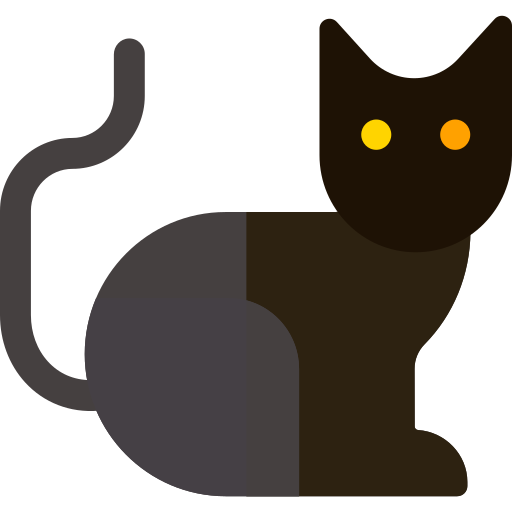
des chats
cats
Dans la maison, il y a des chats.

des hommes
men
Des hommes parlent.

les filles
the girls
Les filles parlent.

Nous sommes Américains.
We are Americans.

Nous parlons.
We are talking.
Nous parlons fort.
Nous parlons espagnol.
We speak Spanish.

Les hommes parlent.
The men talk.
Les hommes parlent doucement.
Ils parlent très bien le français.
They speak French very well.
Ils parlent très bien le français, vous parlez bien l'espagnol.

Ils mangent une pizza.
They are eating a pizza.
Ils mangent une délicieuse pizza avec du fromage.
*Tell us what you like*
"Aimer" is a French *regular verb* meaning *to like* or *to love.*
"j’aime"
"tu aimes"
"il/elle aime"
"nous aimons"
"vous aimez"
"ils/elles aiment"
In French, using "aimer" alone means *to love.* If you want to say you like someone, you add words like "bien" or "beaucoup" to "aimer."
For example: "J'aime bien ce film." means 'I like this movie.'

J'aime les croissants.
I love croissants.

l’océan
the ocean
J'aime l'océan.
J'aime le français.
I love French.
J'aime le français. Tu aimes l'espagnol.

Tu aimes les spaghettis ?
Do you like spaghetti?
J'aime la pizza, tu aimes les spaghettis.

Elle aime la musique.
She likes music.
la danse
the dance
J'adore la danse !
J'aime la danse.
I love dancing.
un cheval
a horse
Le cheval est un bel animal.

Elle aime les chevaux.
She loves horses.
Jean aime les chevaux et Pierre aime les chats.

Je t'aime bien.
I like you
Je t'aime bien. Tu m'aimes bien ?

Je t’aime !
I love you !
*To have & to go*
Most French verbs change really predictably; these are regular verbs. However, some verbs just do their own thing and don't follow typical patterns. *A good example is the verbs 'to be' and 'to go'.*
Let's take a look at them in the singular form.
TO HAVE: "AVOIR"
"j'ai"
"tu as"
"il / elle a"
TO GO: "ALLER"
"je vais"
"tu vas"
"il / elle va"
J'ai un chien.
I have a dog.
J'ai un chien et elle a un cheval.

une sœur
a sister
Ma sœur est belle.

un frère
a brother
Mon frère aime danser.

Elle a une sœur.
She has a sister.
Elle aime jouer avec sa sœur.

Tu as des frères et sœurs?
Do you have siblings?

une école
a school
J'aime mon école.

Je vais à l'école.
I am going to school.
Il aime aller à l'école.

Tu vas à l'école ?
Do you go to school?
Tu aimes aller à l'école ?

J'aime aller à l'école.
I like to go to school.
*Using two verbs in one sentence*
In French, you can use two verbs in one sentence, just like in English. Only one of them is conjugated and the other one remains in its infinitive form.
So, for example, if you want to say *I like to run,* only the verb "aimer" (to like) would be conjugated:
"J’aime courir."

J'aime manger.
I like eating.
Tout le monde aime manger.

une pomme
an apple
Tu manges une pomme.
Elle aime manger des pommes.
She likes to eat apples.
C'est bien de manger des pommes !

Il aime avoir un chien.
He likes having a dog.

chanter
to sing
Ma sœur aime chanter.

Tu aimes chanter.
You like singing.

nager
to swim
Tu aimes nager.

Ma sœur aime nager dans l'océan.
My sister loves swimming in the ocean.
Et toi, tu aimes nager dans l'océan ?

Je nage et tu cours.
I swim and you run.
Nous aimons le sport, je nage et tu cours.

le yoga
the yoga

faire du yoga
to do yoga
Il fait du yoga tous les jours.
*Do you live in France?*
When referring to the place where you live, in French, we typically use the preposition "à" for cities and "en" for countries:
"J'habite à Paris." (I live in Paris.)
"J'habite en France." (I live in France.)
However, there are some countries for which we use the preposition "au" when the country's name is masculine. For instance, "au Maroc" for Morocco, "au Mexique" for Mexico, or "au Portugal" for Portugal.

J'habite à Paris.
I live in Paris.
J'habite à Paris, et toi ?

Londres
London
Elle habite à Londres.

travailler
to work
Je travaille, et toi ?

Je travaille en Espagne.
I work in Spain.
Je travaille en Espagne et Pierre travaille en France.

Madrid est en Espagne.
Madrid is in Spain.
Madrid est en Espagne, Paris est en France.

Italie
Italy
Je vais en Italie.

J'aime travailler en Italie.
I like working in Italy.
J'aime travailler en Italie, tu aimes travailler en Espagne.

Je suis en Europe.
I am in Europe.
J'habite en Europe.

étudier
to study
J'étudie au Portugal, et toi ?
à la maison
at home
Je suis à la maison avec ma sœur.
*My Family*
In French, possessives function differently from English. *They change based on the gender of the word which is following them.* For example, the word 'my' will differ depending on whether you're referring to your mother (feminine) or your father (masculine). Take a closer look:
"mon père" - my father
"ma mère" - my mother
"ton frère" - your brother
"ta sœur" - your sister
"son fils" - his / her son
"sa fille" - his / her daughter

ma mère
my mother
Ma mère est à la maison.

ton père
your father
Tu aimes ton père.

l'animal de compagnie
pet
Mon animal de compagnie est un chien.

son animal de compagnie
his pet
Son animal de compagnie est un chat.

un jardin
a garden
Ma mère est dans le jardin.

une fleur
a flower
J'ai des fleurs dans mon jardin.

magnifique
beautiful
Wow, cette plage est magnifique !

Ton jardin est magnifique.
Your garden is beautiful.

Ta sœur s'appelle Marie.
Your sister's name is Maria.
Ta sœur s'appelle Marie et mon frère s'appelle Pierre.

Mon frère travaille à Londres.
My brother works in London.
Mon frère habite et travaille en Espagne.
*An extra -s*
If you're talking about a plural noun, add *-s* to the adjective too.
"La femme est contente." The woman is happy.
"Les femmes sont contentes." The women are happy.
Even possessives change in plural!
"mes frères" - my brothers
"tes sœurs" - your sisters
"ses parents" - his / her parents

le garçon et ses parents
the boy and his parents
Le garçon et ses parents vont en Belgique.
les animaux sont contents
the animals are happy/satisfied

mes frères aiment la pizza
my brothers like pizza
petit
small
Tes frères sont encore petits.
grand
big/tall
Le jardin de mon père est grand.
tes parents
your parents
Tes parents habitent au Méxique.

mes parents et moi
me and my parents
Mes parents et moi allons à Paris.

Tes sœurs parlent le français.
Your sisters speak French.
Tes sœurs parlent très bien le français.

les maisons
the houses

Les maisons sont grandes.
The houses are big.
Les maisons à Lyon sont grandes.

un chat mignon
a cute cat
Tes chats sont mignons.
*French 'de'*
"De" in French has various meanings. You can use it when:
- you want to say that *something belongs to someone:* "le chat de Paul" - Paul's cat
- it also allows you to say *'of'* - "une tasse de café" - cup of coffee
- it can also be translated as *'from'* when you want to say where you come from. -
"Je suis de Paris." - I'm from Paris.

Le chat de Julie
Julie's cat
Le chat de Julie est mignon.

le jardin de mes parents
my parents' garden
Le jardin de mes parents est grand et beau.

une tasse de café
a cup of coffee
Elle boit une tasse de café le matin.

mon mari
my husband
les chaussures de mon mari

ma femme
my wife
Ma femme aime travailler dans le jardin.

les chaussures
the shoes
Ma femme a de belles chaussures.

les chaussures de ma femme
my wife's shoes

les chats de ma mère
my mother's cats
Les chats de ma mère sont grands.

Je suis de Paris.
I'm from Paris.
Je suis de Paris et il est de Madrid.

Tu es de Londres ?
Are you from London?
Il a beaucoup de chiens.
He has a lot of dogs.
Il a beaucoup de chiens parce que son jardin est grand.
*Numbers*
Let´s learn first ten numbers in French.
"un" - one
"deux" - two
"trois" - three
"quatre" - four
"cinq" - five
"six" - six
"sept" - seven
"huit" - eight
"neuf" - nine
"dix" - ten
As you can see, the word for *number one* is *the same as the indefinite article.* It also changes based on gender, just like the indefinite article: in the masculine, it's *'un'* - "un chien" (one dog), while in the feminine, it changes to *'une'* . "une pomme" (one apple)
deux pommes
two apples
Je mange deux pommes tous les jours.

trois maisons
three houses
Pierre a trois maisons à Madrid.
une semaine
one week
J'aime partir en vacances une semaine.

un voyage
a travel/a trip
Il prépare son sac pour le voyage.

cinq jours
five days
Le voyage dure cinq jours.

un an
a year/one year
Sa fille est petite - elle a un an.

Ma sœur a dix ans.
My sister is ten years old.
J'ai neuf ans et ma sœur a dix ans.

Il y a huit fleurs dans le jardin.
There are eight flowers in the garden.
*Talk about things you do*
It's time to learn to talk about things you do, like your job or simply what your plans are for tonight.
Remember, in French, "à" and "le" are never used together. Instead, they combine into "au".
For example: "Tu vas au restaurant." ( 'au' is a combination of 'à' meaning 'in', and 'le' as a definite article.)

Je suis étudiant.
I'm a student.
Il y a trois étudiants dans le jardin.
un travail
a job
Tu as un travail ?

Je suis médecin.
I'm a doctor.
Je suis médecin. Et toi ?

C’est mon médecin.
He's my doctor.

J'aime mon travail.
I love my job.
J'ai un très bon travail.

J'étudie la musique.
I'm studying music.
Pierre étudie la musique et Jean étudie l'art.

au cinéma
to the cinema

aujourd'hui
today
Aujourd'hui, je vais à l'école.
Aujourd'hui, nous allons au cinéma.
Today we're going to the cinema.
Nous allons au cinéma avec mes frères et mes sœurs.

Elle va au zoo.
She's going to the zoo.
Elle aime aller au zoo.
*Plural forms of the verbs to have and to go*
Let's learn to conjugate the verbs *to have* and *to go* in plural:
TO HAVE - "AVOIR" :
"nous avons"
"vous avez"
"ils/elles ont"
TO GO - "ALLER" :
"nous allons"
"vous allez"
"ils/elles vont"
Let's practice!

Nous avons une fille.
We have a daughter.
Nous avons une fille. Elle a huit ans.
Ils vont à l'école.
They are going to school.
Aujourd'hui, mes frères vont à l'école.

Vous avez une belle femme.
You have a beautiful wife.

Nous avons une maison.
We have a house.
Nous avons une grande maison, ils ont une petite maison.

Ils ont des enfants.
They have children.
Ils ont quatre enfants.

N’est-ce pas ?
Right?

Vous avez des enfants, n'est-ce pas ?
You have children, right?
Nous avons trois grands chevaux.
We have three large horses.
Nous avons trois grand chevaux et vous avez trois petits chiens.
*French negation*
To form a sentence with French negation, the *basic structure* is as follows: *ne + verb + pas.*
"J’aime apprendre le français." - I like learning French.
"Je n’aime pas apprendre le français." - I do not like learning French.
Negation can alter the articles. Definite articles like "le, la, l'," or "les" remain unchanged by negation. However, when using indefinite articles such as "un, une," and "des," they transform into "de" or "d’" after a French negation.
"J'ai un chien." - I have a dog.
"Je n'ai pas de chien." - I don't have a dog.
Notice that the *ne shortens to n’ when it precedes a vowel.*

Je n'aime pas courir.
I don't like running.
Je n'aime pas courir, j'aime nager.

Je n'ai pas ...
I don't have...
Je n'ai pas d'animaux.
Je n'ai pas d'enfants.
I don't have children.

Il n'a pas de chien.
He doesn't have a dog.
Il n'a pas de chien mais il a un chat.
Je ne parle pas français.
I don't speak French.
Je ne parle pas français, mais je parle bien anglais.

jamais
never
le fromage
cheese
un bon fromage

Je n’aime pas le fromage.
I don't like cheese.
Je n'aime pas le fromage. Et toi, tu aimes le fromage ?

boire
to drink
Elle aime boire du café.
Je ne bois pas d'alcohol.
I don't drink alcohol.
Je ne bois pas d'alcool, mon père ne boit pas de café.
Nous n'aimons pas apprendre.
We don't like to learn.

Elle n'étudie pas.
She doesn't study.

Bon courage !
Good luck!
Tu vas passer ton examen aujourd'hui ? Bon courage !