
Past continuous + Phrasal verbsEnglish words
by DuoCards
*Common phrasal verbs*
Let's start with some common phrasal verbs that are useful in everyday English!

to go on
The party went on until 3am.

to give up
She didn't give up on her dreams.

to put off
He had to put off the meeting because he was very busy.

to work out
I go to the gym every day to work out and stay healthy.

to find out
We are trying to find out what the problem is.

to get over
I got over it quickly.

to break up
She wants to break up with me.

to look something up
You should look it up on the Internet.

to ask somebody out
He asked me out.

She was too shy to ask him out.
to call off
Jason called the wedding off because he wasn't in love with his fiancée.
I called off the meeting.

to get away with something
She always gets away with being late to class.

to sort something out
I need to sort this problem out before the meeting.
*Past continuous tense*
We use *Past Continuous tense* to refer to a *continuing action or state that was happening at some point in the past*.
This tense is formed by combining the past tense of "to be (was/were)" with the verb’s present participle *("-ing" word).*
It is often used to describe *conditions that existed in the past.*
"The sun was shining every day that summer."
"It was snowing yesterday."
"They were eating at the restaurant."

effort
She put a lot of effort into her homework.

to explore
I want to explore the forest this weekend.

a possibility
She considered the possibility of moving to another city.

They were exploring different possibilities for their holiday.

holiday
She was exploring the possibility of taking a holiday in Spain.

I was reading a book yesterday evening.

They were playing football in the park.

It was improving.
His condition was improving.
I was listening carefully.
"Was" or "were" - *What to use?*
Remember to change the verb "to be" so *it matches the subject.* Use "was" with "I, he, she," or "it", and use "were" with "you, we," or "they."
"She was working on an email when the fire alarm rang."
"The team was playing well until the second half."
Use "were" for all other subjects, including all plural subjects. "Were" is also used with "you".
"The days were getting shorter as winter approached."

The days were getting longer.
The days were getting longer as summer approached.

They were traveling a lot.
They were traveling a lot last summer.

My mother was cooking.
My mother was cooking the dinner when we arrived.

We were dancing all night.
Was it raining?
Was it raining the whole day?

He was studying last night.
They were sleeping.
While they were sleeping, the cat jumped on the bed.
*Past continuous questions*
1. Questions that can be answered with *yes* or *no* are formed by inverting the subject and correct form of the verb *be ("was/were").*
"Was he studying all night again?"
2. Wh- questions can not be answered with yes or no.
"Where was he going?"
to snore
He snores loudly.

Was she improving?
to overcome
He had to overcome many obstacles to achieve his dreams.
Were you studying all night?

Were we talking too loud?

to measure
We want to measure your blood pressure.

What was he measuring?
Where were you going?
Where were you going last night?
What was he doing?

to run late
He was running late again.
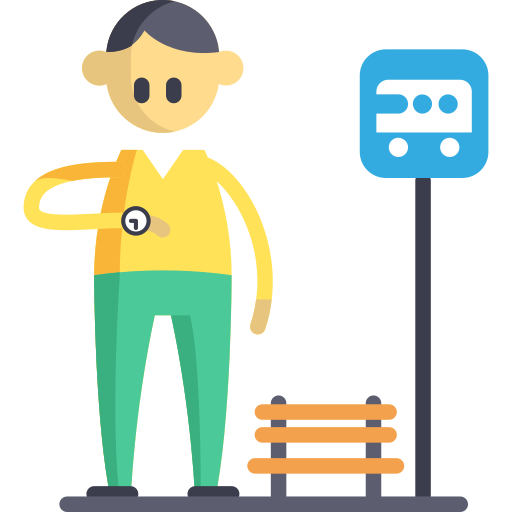
Why were the buses running late?
*Past continuous negative form*
To make a positive statement *negative*, add "not" before the *verb + "-ing"*.
"You were not doing your homework."
You can also use a *contraction (wasn't / weren't).*
"You weren't doing your homework."
He wasn't planning it.
She was surprised because he wasn't planning it at all.

I wasn't running late.
I wasn't running late for the movie, I arrived just as the previews were starting.

They weren't studying all night.
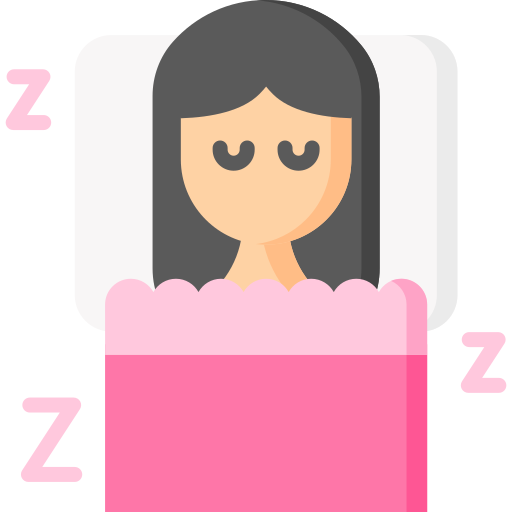
She wasn't snoring.
Last night she wasn't snoring.

My mother wasn't cooking.

The children weren't sleeping during the drive home.

to tell the truth

My boyfriend was not telling me the truth.

You were not doing your homework.
*Spelling changes*
Be careful as there are also some *spelling changes* when you create the *-ing form* of verbs.
*For verbs that end with one -e, drop the -e and add -ing.*
"live - living"
"make - making"
"give - giving"
*With verbs ending with a long -e sound, add -ing as normal*
"see - seeing"
"be - being"
"agree - agreeing"
*If a verb ends in -ie change ie to y and then add -ing.*
"die - dying"
"lie - lying"

to agree
We all agreed to meet up at 8:00.

to hide
He tried to hide his profile.

Where were you hiding?
After searching the whole house, I finally found my brother and asked, "Where were you hiding?

He was lying.
He was lying about his age to get into the club.

to die
The main character will die at the end.
My phone battery was dying during the trip.

to make excuses
He is making excuses again.

We were making no excuses.
After the game, we were making no excuses for our loss; we simply needed to play better.
We were living without the internet for two weeks.

I was just being polite.
I didn't really want to go to the party, but I was just being polite.

homeless people
We were giving food to the homeless people.
*When to double the last letter?*
If the verb has *one syllable* and *ends with CVC* (a consonant + vowel + consonant), we *double the final consonant* before adding the -ing ending.
"run - running"
"plan - planning"
We also double the final consonant *if the last syllable is stressed.*
"begin - beginning"
"forget - forgetting"
However, *do not double* the consonant *for verbs that end in w, x or y.*
"stay - staying"
"show - showing"
"wax - waxing"
to forget
I keep forgetting to drink water!
I keep forgetting
I keep forgetting to take my medication.
to begin
It was beginning to snow.

It was beginning to rain.
It was beginning to rain when we got home.

to show the way
I can show you the way.

She was showing him the way.

I was shopping.
My parents arrived while I was shopping.

to stay up
I decided to stay up late to finish my homework.

She was planning her holiday to Italy.

We were staying at a small hotel near the beach.

We were planning on telling you.
When were you planning on telling me?
The team was playing well.
The team was playing well until the second half.

to stick to something
You will lose weight if you stick to the diet.
*Past continuous and Past simple*
Past continuous tense can also be used to describe something that *was happening continuously in the past* when another action *interrupted it.*
"I was making dinner when she arrived."
*Notice:* Not every verb describes a continuous action! Certain verbs *can’t be used in the past continuous tense.*
One common example is the verb "to arrive".
Wrong: "At noon, he was arriving."
Correct: "At noon, he arrived."

I was reading when he knocked.

She was cooking when I came home.

to get home
What time did you get home last night?

When I got home, they were eating.
When we arrived, you were sleeping.

after I left
After I left, everyone at the party was still having fun.
What were you doing after I left?

Nobody was dancing when the music stopped.
*Past continuous + Phrasal verbs*
Let's combine the past continuous tense with some of the phrasal verbs we've just learned!
I was setting up the meeting.
I was setting up the meeting when I saw him.

She was breaking up with her boyfriend.
When I saw her, she was breaking up with her boyfriend.

He was looking it up.
She was looking it up on her phone during the meeting.

Things were working out.
After a few weeks of hard work, things were working out for the team.

We were already giving up.
When the rain started, we were already giving up on our picnic plans.
She was getting over the flu when I visited her.

I was working out when they called me.
*Verbs you cannot use in the past continuous tense*
There is a certain type of verb that cannot be used in any continuous tense, including the past continuous tense. These are called *stative verbs.*
Because stative verbs are inherently continuous, it sounds odd to put them in a continuous tense. You can use them *in the simple past* instead.
Stative verbs are for example: "love", "like", "believe", "seem", "need", "want", etc.

It seemed easy.
It seemed easy at first.

We loved the movie!
We loved the new movie from Tarantino!

He wanted to go.
He wanted to go to the party but he couldn't.

I need to go home.
After a long day, I need to go home and relax.

to realize
He realized his mistake at once.

I realized later.
I realized later that he was lying to me.

She believes everything I say.

We understood your question.
We understood your question but we didn't know the answer.
*Wishes and hypotheses*
We can also use the past continuous *to refer to the present or future in hypotheses* (when we imagine something), or in a few polite expressions.
"These seats are very uncomfortable. I wish we were traveling first class."
"If Jack was playing, they would probably win."
"Excuse me, I was wondering if this was the train for New York."

I wish he was telling the truth.

I was wondering if...
I was wondering if you could help me.
I was wondering if you could help me with my homework.
If only he wasn't snoring.
If only he wasn't snoring, I could finally get some sleep.

I wish it wasn't raining.

to pass an exam
Did you pass the exam?
If he was studying, he would pass the exam.
I wish I was sleeping right now.
After a long day, I wish I was sleeping instead of doing homework.

They wish things were working out.