
Talking about the PastEnglish words
by DuoCards
*The Past Simple Tense*
Let’s start with *the past simple tense.* We use it to talk about *completed actions that happened in a time period before now.*
We distinguish between regular and irregular verbs, which we will look at later.
*Regular verbs in the past simple: add "-ed" to most verbs:*
"to talk" - "talked"
"to finish" - "finished"
"to listen" - "listened"
"to relax" - "relaxed"
"to knock" - "knocked"
"to walk" - "walked"
I finished the school project.

to listen
We listened to some music.
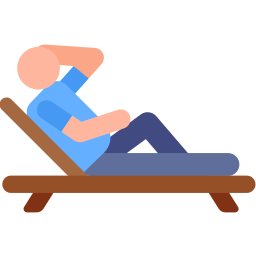
he relaxed
He relaxed during his vacation.

He listened to my advice and relaxed.

We talked about our favorite movies.

to knock
Who knocked at the door?

he knocked
He knocked at the door.

to walk in
She walked in.

He walked in.
He knocked on the door and walked in.
*Double the last letter*
If a *short verb* ends with a *consonant-vowel-consonant*, double the last letter and then add -ed.
"to stop" - "stopped"
"to shop" - "shopped"
However, do not double the last letter if the verb ends in *w, x* or *y.*
"to play" - "played"
"to show" - "showed"

to stop
The bus driver stopped suddenly.
we stopped
We stopped playing soccer when it started to rain.

in the middle
She placed the vase in the middle of the table.

the desert
The desert is very dry and salty.

We stopped in the middle of the desert.
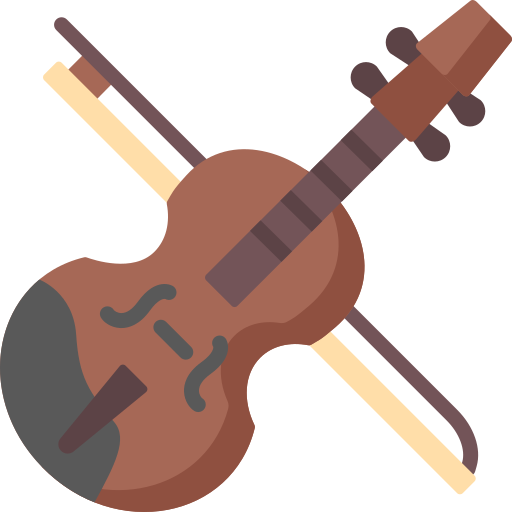
to play
The violinist played beautifully.

She played guitar.
She played guitar at the concert.

to shop
They shopped a lot.

to show
He showed me the way.
*Longer words*
In longer words, if the last syllable of the verb ends with a consonant-vowel-consonant and that syllable is stressed, double the last consonant and then add ed.
"to prefer" - "preferred"
"to travel" - "traveled" (American English) or "travelled" (British English)
However, do not double the last letter if the *first syllable is stressed.*
"to enter" - "entered"
They entered.
They entered the house.

to prefer
I prefer alternative medicine.

to travel
We traveled a lot as children.
alone
He was alone that evening.

I traveled alone.
I traveled to the USA alone.

preferred option
Travelling by train would always be my preferred option.

last summer
We met last summer.

He traveled by boat last summer.
*The endings change*
If the verb ends in e, just add *-d.*
"to create" - "created"
"to live" - "lived"
If the verb ends in a consonant + y, *change the y to i and add -ed.*
"to try" - "tried"
"to worry" - "worried"
"to carry" - "carried"

to create
He created an environment in which students can learn.

he created
He created his own website.
The company created a new app for learning languages.

to live
We lived abroad for six years.

We lived together.
We lived together for many years.

to worry
She is worried about her interview, even though she did fine.
she worried
My mum worried about me last week because I was ill.

to carry
Let me carry your bags for you.

I carried the bag.
*Expressions - past simple*
There are certain expressions associated with the past simple tense:
"yesterday"
"last week/month/year/..."
"ago" expresses temporal distance and always stands after a temporal determination.
e.g.. "one month ago" "two weeks ago" "a long time ago" "the other day"

I cooked a vegan meal last weekend.

last weekend
I went hiking with my friends last weekend.

I studied a lot last night.

I played
l played tennis alone.

I played a difficult game yesterday.
to borrow
Can I borrow your car?
two years ago
We moved in two years ago.

He borrowed money from his parents two years ago.

to try
She tried to contact her father.

to call
I called you ten times!

I tried to call him three hours ago.
*Verbs ending in -d*
Some verbs that end in -d, change the *-d* to *-t*.
"to build" - "built"
"to send" - "sent"
"to bend" - "bent"
"to spend" - "spent"
Example: "We built this house a long time ago."

to build
Who built this house?
We built a house.

to send
I sent an email.

I sent you a message.

to bend
The tree branches bend in the wind.
to bend over
I bent over and picked up the coin.
The tree bent in the strong wind.

to spend
She spent a lot of money.

I spent all night studying.

We spent a lot of money.
We spent a lot of money on the holidays.
*Past Simple - to be or to go*
Irregular verbs have *three specific forms* that you need to memorize. While most English regular verbs use the ending *-ed* for the past tense and participle forms, irregular verbs *each have their own unique tense forms and past participles.*
The three forms are:
1. *Base form* (the verb you find in the dictionary)
2. *Past simple form* (the one you are learning in this course)
3. *Past participle form* (we will learn how to use this later)
It is important and much easier to learn all three forms at the same time. Let's start with the most important ones:
"to be" - "was/were" - "been"
"to go" - "went" - "gone"

to be
He was sad yesterday.
We were happy yesterday.
I was there.
I was at the party yesterday.
scared
She was scared to walk alone in the dark.

He was scared.
He was scared when he heard the loud noise.

a feeling
I have a feeling that today will be a great day.

He was scared of his feelings.

to go
We went to the cinema last night.
he went
He went for a walk.
last Monday
Last Monday we had an exam.

He went to Prague last Monday.
*More irregular verbs*
Now let's take a look at some other irregular verbs and their past forms.
"to have" - "had" - "had"
"to eat" - "ate" - "eaten"
"to come" - "came" - "come"
"to think" - "thought" - "thought"
"to give" - "gave" - "given"
"to forget" - "forgot" - "forgotten"

to have
I had no idea.

we had
We had a great time last weekend.

We had a great time.

to eat
I ate a while ago.

She ate an apple for breakfast.
to come
I came home very late last night.
to think
I never thought I could do it.
I thought so.

I thought of you today.
I thought of you today during my lunch break and smiled.

to give
She gave him a book for his birthday.

The teacher gave us homework yesterday.
to forget
She forgot about it.

I forgot my keys.
to make
I made it myself.

I made a mistake.

We made it to the end!
*Past tense - question*
A question is formed in the past tense by adding the auxiliary verb "did" (past tense of "do") to the beginning of the sentence. This auxiliary verb takes over all grammatical functions, so the semantic verb will already be in the present tense.
"did" + subject + verb (infinitive without "TO") + the rest of the sentence*
"Did you like the concert?"
Let's take a look at some more irregular verbs:
"to know" - "knew" - "known"
"to pay" - "paid" - "paid"
"to sleep" - "slept" - "slept"
"to keep" - "kept" - "kept"
"to mean" - "meant" - "meant"

Did you know that?
Did you know that the Eiffel Tower can be 15 cm taller in the summer?

I knew it.
I knew it was true.

to pay
Did you pay the bills last month?

He paid for me.
He paid for me at the restaurant.
to sleep
Did you sleep well?
He slept for ten hours last night.

Did he study?
Did he study before the exam?

to keep
Did you keep my secret?

Did she go there?

to mean
Did they mean it?
I meant it.
When I complimented your work, I meant it.
*Past tense - negation*
When we want to express a negation in the past tense, we use the phrase "did not" after the subject, and the semantic verb (a verb that shows an action or event) remains in its basic form.
*subject + "did not" + verb (infinitive) + rest of the sentence*
"He did not do it."
"We did not go there."
*Note that "didn't" is a short form of "did not".*
Let's take a look at some more irregular verbs:
"to feel" - "felt" - "felt"
"to tell" - "told" - "told"
"to wear" - "wore" - "worn"

I did not work yesterday.

He didn't do it.
He didn't do his homework.

We did not go there.

to feel
I feel tired after the long day.

I did not feel it.
I did not feel pain.

to tell
I told her you were coming.

She didn't tell me.
She didn't tell me the truth.
the truth
You should tell the truth.

to wear
I didn't wear a school uniform.

I did not sleep well.
*The same form*
Sometimes the past tense form is the same as the infinitive form. Let’s look at these verbs so you don’t get confused!
"to let" - "let" - "let"
"to set" - "set" - "set"
"to put" - "put" - "put"
"to cut" - "cut" - "cut"
"to cost" - "cost" - "cost"
Notice that these verbs can have different meanings depending on how they are used. We are going to learn some of them.

to let
She let her friend use her phone.

Let it be.
She was upset about the argument, but I told her to let it be.
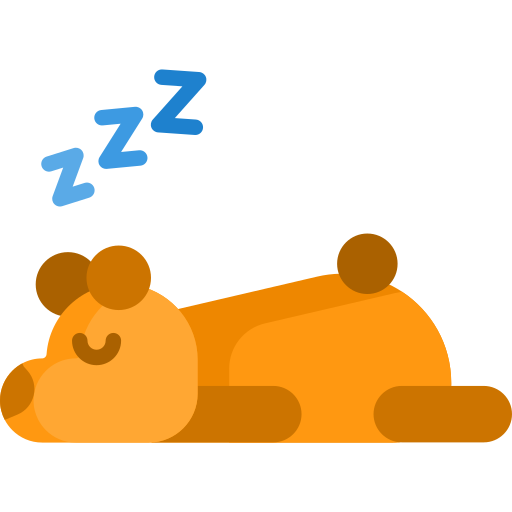
He let his dog sleep on the bed.

to set
He set the ladder against the wall.
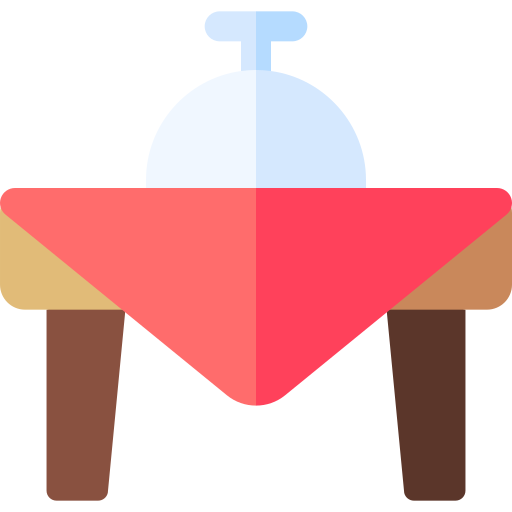
to set the table
Can you help me set the table for dinner?

to set an example
The teacher always tries to set an example for her students.

She set the table for dinner.

to put
He put his arms around her and held her tight.

I put the milk back in the fridge.

to cut
I cut myself while shaving.

I cut my hair yesterday.

Cut it out!

to cost
This book costs ten dollars.

I bought a new phone, and it cost a lot of money.
*Let's wrap up this course!*
Let's wrap up this course with some more *commonly used irregular verbs* that will help you expand your vocabulary.
"to choose" - "chose" - "chosen"
"to write" - "wrote" - "written"
"to take" - "took" - "taken"
"to see" - "saw" - "seen"
"to buy" - "bought" - "bought"
to choose
He chose a seat facing the door.

They chose a movie to watch together.
to write
I wrote my name on the paper.

She wrote a letter to her friend.

to take
It took us more than an hour to get there.

I took care of it.

It took me an hour to finish my homework.

to take a shower
I took a shower and went to work.

to buy
She bought a dress for the party.

I bought a new laptop.

to see
Jack saw Peter last weekend.

I saw you.
I saw you at the park yesterday.

Choose wisely.
Choose wisely your next course.