
Separable and inseparable verbs
Explanations and vocabulary practice

Sections: 9
Save words from this page and practise them with flashcards in DuoCards. How does it work?
Separable verbs ( trennbare Verben) and inseparable verbs ( untrennbare Verben) in German are verbs whose meaning can change with the addition of a prefix.
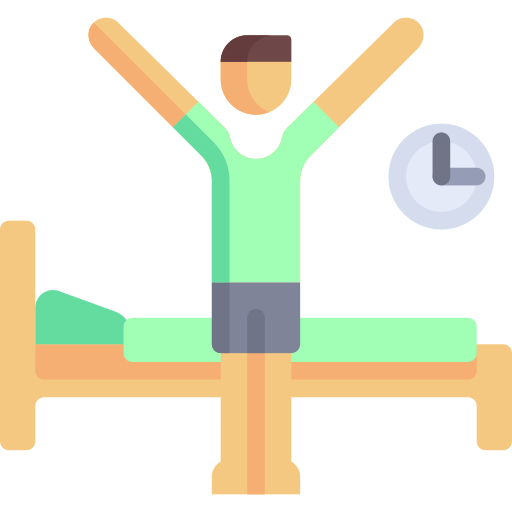
Prefixes that are separable are separated from their verb in the conjugated form (e.g. aufstehen – ich stehe auf).
Whereas, inseparable prefixes can not be separated from their verb (e.g. bestehen – du bestehst).
The prefix determines whether a verb is separable or not.
The meaning changes according to the prefix. Let's look at some verbs derived from the verb stehen.





Let's start with the inseparable prefixes since there are fewer of them than the other ones.
Verbs with the following prefixes are inseparable:
be-, emp-, ent-, er-, ge-, miss-, ver-, zer-
These prefixes remain a permanent part of the verb even if it's conjugated.
Example: Kinder bekommen viele Geschenke zum Weihnachten.













Most verb prefixes are always separable. Since there are far fewer inseparable prefixes, you better memorize the inseparable prefixes.
The verbs with the following prefixes are separable:
ab-, an-, auf-, aus-, bei-, ein-, fern-, los-, mit-, nach-, her-, hin-, vor-, weg-, zu-, zurück-
Let's start with the verbs starting with -a.











Rule 1: If you are using a separable verb in a sentence, and it is the only verb, it is separated. The verb stem is conjugated and goes in position 2. The prefix goes to the end.
Ich stehe um 7 Uhr auf.
Rule 2: If a modal verb is used, separable verbs are not separated.
Ich muss heute nicht früh aufstehen.
Rule 3: German separable verbs are always separated in the imperative.
Steh auf!
Let's take a look at some more separable verbs!


















The verbs with the following prefixes can be either separable or inseparable:
durch-, hinter-, über-, um-, unter-
Some verbs with these prefixes are always separable.
e. g. umschauen – er schaut sich um
Some other verbs with these prefixes are never separable.
e. g. umarmen - sie umarmt ihn
Some verbs with these prefixes can be either separable or inseparable. In this case, the separable verb and the inseparable verb have two different meanings.
For example, umfahren (separable) = means bumping into something until it falls on the ground, and umfahren (inseparable) = drive around something.
Ich umfahre die Innenstadt.
Fahr ihn nicht um!



















Some verbs have two prefixes. Here are the rules you need to keep in mind:
1. inseparable + separable => inseparable verb (verab-: verabschieden)
2. inseparable + inseparable => inseparable verb (verun-: verunglücken)
3. separable + inseparable => separable verb (vorbe-: vorbereiten)









We stress the prefix in separable verbs and the syllable after the prefix in inseparable verbs.
Example:
umfahren (knock down)
umfahren (drive around)
Let's take a look at some useful common phrases!









If you want to use a separable verb in the past tense, you have to incorporate ge into them in order to show that we’re talking about the past. But in their case, ge goes after the prefix and before the verb stem:
aufgeben (to give up) - aufgegeben (gave up)
In this example, the separable verb aufgeben has the prefix auf-. If we want to change it to the past participle, we put ge in between the prefix auf– and the verb stem geben.
We then team it with one of the helping verbs (haben or sein) as usual to form the past participle:
Er hat das Rauchen aufgegeben. He has given up smoking.
In inseparable verbs, the prefix replaces the ge:
Du hast die Frage richtig beantwortet. You answered the question correctly.






Don't confuse the prefix -ge with the -ge that we use for the past tense. The prefix ge does not necessarily indicate the past tense!
Here are some common verbs with the prefix ge.








Learning with DuoCards
What is DuoCards?
DuoCards is a language-learning app that helps you build vocabulary with flashcards. You can save words you want to learn and practise them over time.
How do I learn with this course?
Browse the explanations and vocabulary in each section. Select Card picker and choose the words you want to learn. Then create a free account to save your words and practise them.
How do I practise my words?
You'll see a flashcard with a word and a hidden translation. Guess what it means, then tap to check your answer. DuoCards repeats the words you find difficult.
Do I need an account, and is learning free?
You can browse this page without an account. A free account lets you save words and track your progress. The free plan has limits, and Premium offers additional features.